

Drains are a part of the house that we don't think about until something goes wrong. Whether you're in a tiny apartment or a sprawling house, drains quietly do their job, dealing with used water and waste. But once they stop working, things can go awry -- quickly. A clogged drain can throw your whole day off track, and if left untreated, it can cause bigger issues, such as leaks and water damage.
Our Picks
What we liked:
Pros
- Versatile drain cleaner
- Dissolved pet hair and other clogged items with ease

What we liked:
Pros
- Worked quickly
Cons
- Not ideal as a long-term solution
It's inevitable that one of your drains will one day find itself packed with hair, food scraps or whatever else gets stuck in them. But don't panic; you might not need to resort to paying a small fortune for an emergency plumber. Oftentimes, you just need the right drain cleaner. We tested eight liquid chemical drain cleaners in our Louisville, Kentucky, laboratory from popular brands, including Drano, Liquid-Plumr and Green Gobbler. After putting them through their paces, we've found the top performers that are worth keeping under your sink, just in case.
What is the best overall drain cleaner?

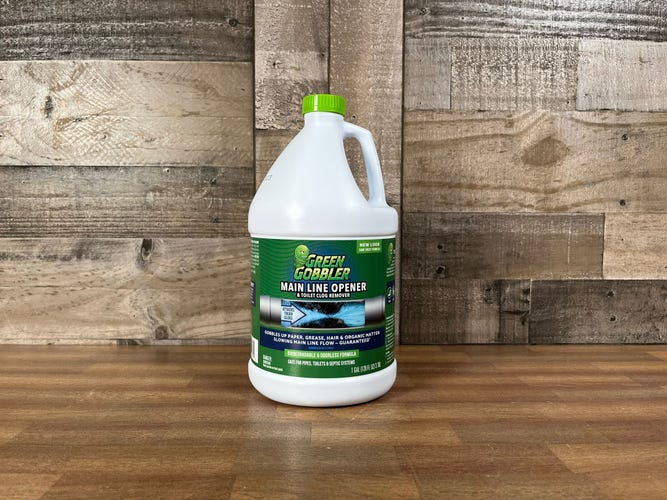
The Green Gobbler Main Line Opener emerged as the top performer in our batch dissolution test.
During our lab testing, we found the Green Gobbler Main Line Opener performed best at clearing clogs. It’s worth noting that the Green Gobbler Main Line Opener claims to be safe for toilets, sinks, tubs, showers and even septic tanks. It's available for an affordable price, often found on sale, and doesn't have to be purchased in bulk like some other options on our list.

Pros
- Versatile drain cleaner
- Dissolved pet hair and other clogged items with ease
What we liked:
Averaging $25, the Green Gobbler Main Line Opener emerged as the top performer in our batch dissolution test, excelling in almost every category. It successfully dissolved 100% of the pet hair, 78% of the organic compounds, 35% of the grease and 16% of the paper products. that we had in the drain. When mixed with water, the solution maintained a moderate level of basicity with a pH of 10.73, and it generated minimal heat, as evidenced by the negligible increase in water temperature after mixing (less than 0.5 degrees Celsius).
One of its key ingredients is lauramine oxide, a surfactant that is resistant to bleach. This feature is particularly important because the Green Gobbler Main Line Opener doesn't rely solely on its bleach-lye mixture for dissolving and unclogging. A bleach-stable surfactant refers to a chemical substance that remains mostly unaffected by the presence of bleach while reducing the surface tension of the liquid in which it is dissolved. In this case, the water-drain cleaner solution mixture works inside your drains.
Reducing the surface tension of a liquid offers several benefits, such as enhancing its spreading and wetting capabilities. In chemistry terms, spreading and wetting occur when a liquid comes into contact with a solid, adhering to it and spreading evenly around it. This action promotes the formation of chemical bonds at the surface, and in the case of drain cleaner solutions, it effectively disintegrates and dislodges the clogging solid debris, restoring the smooth flow of water, chunk by chunk.
What to keep in mind:
The Green Gobbler Main Line Opener offers versatility, claiming to be safe for use on various piping systems, including toilets, sinks, tubs, showers and even septic tanks. It is crucial to exercise extreme caution and carefully follow all instructions and safety recommendations provided.

Pros
- Worked quickly
Cons
- Not ideal as a long-term solution
What we liked:
The Zep 10-minute Drain Opener Gel is around $8, but it punched above its weight in our lab, performing remarkably well in our dissolution test. It effectively dissolved 70% of the hair, 80% of the organic matter and 15% of the grease, and 16% of paper products. That’s terrific, considering the price for a 64-ounce bottle.
The chemical composition of this drain opener gel includes isopropanol and strong bases such as bleach, lye and caustic potash. When mixed with water, it resulted in a solution with the least alkalinity compared to other drain cleaners, measuring a pH of 8.49. We also observed a slight increase in water temperature of approximately 4 degrees Celsius upon mixing.
What to keep in mind:
Although the product claims to be safe for most piping systems, it's important to note that it is designed for rapid action, using only 16 ounces within a 10-minute time frame as instructed. This rapid action leads to a moderate amount of heat generation, which may not be ideal for prolonged use. While it serves as a great emergency option, I wouldn't recommend relying on this product long-term.

Pros
- Great value
Cons
- Only available to purchase in bulk online
- Not safe to use on any metal or porcelain surfaces
What we liked:
The Santeen Sulfuric Acid Drain Opener proved to be the most potent among all the chemical drain cleaners we tested, effectively dissolving 80% of the hair, 80% of the organic matter, 40% of the grease and 76% of the paper products we used. When combined with water, it creates a highly acidic solution with a pH of 1.59, roughly the same acidity as the gastric fluids in your stomach. For additional safety considerations, please refer to the section below on how we test chemical drain cleaners.
A six-pack of 32-ounce bottles of this concentrated sulfuric acid cleaner is currently priced at around $60. Considering that the instructions typically recommend using only half the bottle, it offers excellent value for your money.
What to keep in mind:
While the product claims to be safe for septic tanks and drain fields, it's important to note that, due to its strongly acidic and corrosive nature, it isn't safe to use on any metal or porcelain surfaces.
Please exercise extreme caution when using this product and carefully follow all instructions and safety recommendations provided on the bottle.

Our top pics all performed exceptionally well during our hands-on testing.
Comparing drain cleaners
| Drain cleaner | Pet hair dissolved during testing | Organic compounds dissolved during testing | Grease dissolved during testing | Paper products dissolved during testing | Price |
|---|---|---|---|---|---|
| Green Gobbler Main Line Opener | 100% | 78% | 35% | 16% | $25 for one-gallon |
| Zep 10-minute Drain Opener Gel | 70% | 80% | 15% | 16% | $8 for 64-oz bottle |
| Santeen Sulfuric Acid Drain Opener | 80% | 80% | 40% | 76% | $60 for a six-pack of 32-oz bottles |
How we tested chemical drain cleaners
I leaned on my background as a chemical engineer to offer insights on the effectiveness of these controversial chemicals. In my experiment, I tested eight of the most commonly available chemical drain cleaners: six alkaline and two acidic. I performed dissolution tests to evaluate how well each of them could dissolve drain blockages. I had one goal: to determine which products, if any, would work effectively against the most common clogging materials.

200 ml of Drano Max Gel
For this rundown, I headed to CNET's product testing lab in Louisville, Kentucky, to conduct a comprehensive batch distillation experiment with eight of the most commonly used chemical drain cleaners on the market. My primary objective was to determine the efficiency of each product in dissolving various types of clogging materials, including organic matter, grease, paper products and pet hair (the same pet hair we use for our robot vacuum tests, as a matter of fact). Throughout the experiment, I also noted the pH levels of the cleaning solutions when mixed with water and monitored any temperature changes. Furthermore, I considered the chemical composition and versatility of use of each product when comparing them to one another.
Categorizing the cleaners
Before conducting experiments with these substances, I separated them into acids and bases. As you may recall from high school chemistry, acids are compounds that donate a hydrogen ion (H+) when mixed with water and have a pH lower than 7. On the other hand, bases are compounds that accept those ions (or hydroxide, OH- ions) and have a pH higher than 7. Understanding this distinction is crucial, due to two important factors associated with these products: corrosivity and causticity.
Corrosivity refers to the potential of a chemical substance to cause rust and deterioration of the materials that make up your piping system. Causticity, on the other hand, relates to how a chemical substance reacts when it comes into contact with organic matter, specifically breaking down proteins and other organic molecules, which can lead to tissue destruction or chemical burns.
To determine the acidity or basicity of each compound, we measure their pH. In simple terms, the more acidic or basic a compound is, the greater its potential for corrosivity and causticity.

Sample pH reading from one of our test subjects. 11.38 pH corresponds to an alkaline solution.
Acidic drain cleaners, particularly those with high acid concentrations like sulfuric acid drain cleaners, are more hazardous compared with their basic or alkaline counterparts. In chemistry, the order of addition does matter. Normally, you would gradually introduce an acid to water, slowly increasing the concentration of the acid. Never add water to an acid as this reaction is known to generate a significant amount of heat and release hazardous fumes. See for yourself in the GIF below (and don't try this at home).
Adding water into this beaker of sulfuric acid creates an immediate exothermic reaction, boiling the water on contact and releasing hazardous smoke into the air. Do not try this at home!
To ensure safety during the experiments, I took necessary precautions by wearing personal protective equipment, including safety goggles, gloves, long-sleeved clothing and a mask. The dissolution test was conducted in a well-ventilated laboratory area to minimize exposure to any hazardous fumes that may be released.
Dissolution test
To begin the experiment, I weighed specific amounts of the clogging materials into separate 1,000 ml beakers:
- 4 grams of hair
- 20 grams of organic matter (10 grams each of apple peels and carrot peels)
- 40 grams of lard for grease
- 14 grams of paper products (7 grams each of toilet paper and paper towels)
Using a graduated cylinder, I carefully measured and added 200 ml of each basic drain cleaner and 70 ml of each acidic drain cleaner to the respective beakers, stirring the mixtures with a glass rod and ensuring thorough mixing without spills. Following the instructions provided with each product, I allowed the solutions to sit for the recommended time, typically between 15 and 30 minutes.
A crucial step in my test was the inclusion of water, a component often overlooked in similar experiments found online. Chemical drain cleaners are designed to work in the presence of water, which facilitates the transportation of the cleaner to the clogs and evenly distributes the solution over their surfaces, enabling the dissolution process. After the designated time had elapsed, I added tap water to each beaker containing the cleaner solutions and clogging materials. For basic drain cleaners (pH > 7.0), I used 500 ml of hot water at 46 degrees C, while for acidic drain cleaners (pH < 7.0), I used 700 ml of cold water at 19 degrees C.
To allow sufficient time for the chemicals to work, I left the samples to sit overnight and resumed the evaluation the following morning. By this point, the samples had transformed into sludgy, slimy mixtures.

Hair dissolution test in progress
To proceed with the experiment, I employed a vacuum filtration process using a Buchner funnel connected to a 1,000ml filtering flask equipped with a pump. The contents of each beaker were carefully poured into the funnel while the pump was activated. Once most of the chemical drain cleaner had been drawn out of the funnel, I performed a water wash to remove any residual chemicals from the surface of the debris samples, ensuring that only wet solids remained in the Buchner funnel.
Our Buchner funnel, made of chemically resistant borosilicate glass, featured a perforated plate with 2ml openings, allowing only the tiniest particles to pass through. In my test logic, "if a substance, solid or liquid, could pass through the 2mm openings in the filter, it was highly unlikely to cause pipe clogging."

On the left, our vacuum filtration setup. Liquid and dissolved solids pass through 2mm holes in the Buchner funnel plate on the right -- anything that doesn't pass through is considered potential clog material.
Finally, I separated the samples and subjected them to a fan-drying process for a few hours to evaporate any remaining water from the wash. I recorded the final weight of each sample and compared it to its initial weight. The ratio of the final weight to the initial weight provided us with the dissolution efficiency of each drain cleaner product.
Liquid drain cleaner vs. professional plumber
Most reputable plumbers strongly advise against using chemical drain cleaners, citing potential damage to plumbing systems and health hazards from harmful fumes. Instead, they recommend regular maintenance, preventive measures and nonchemical alternatives as the best choices for most homes.
Before you purchase a chemical drain cleaner for a chronic case of drain blockages, we recommend that you contact a plumber and ask for advice. Ideally, drain clogs should be removed mechanically (like with a plumbing snake operated by a trained professional). You should also get a thorough inspection to determine the root cause for a long-term solution. If you've already tried a chemical drain cleaner, inform your plumbing professional in advance. Withholding this information can put both your and their health and safety at risk.
Other chemical drain cleaners we've tested
Liquid Plumr Industrial Gel: A great option for effectively dissolving hair and organic matter, this drain cleaner is reasonably priced and claims to be safe to use with most types of pipes. The only reason it didn't secure the top spot on our list is its ineffectiveness at dissolving paper products and its highly alkaline nature, 11.01 pH.
Eco Punch Drain Clog Dissolver: With the lowest dissolution performance among the products tested, this drain cleaner could not make our list. Itt achieved a 40% dissolution rate for hair, 72% for organic matter and only 1% for both grease and paper products. Additionally, it had the highest alkalinity of the bunch: 11.33 pH when mixed with water.
Drano Max Gel: Moderate performance in dissolving hair and organic matter, achieving a dissolution rate of 60% and 59%, respectively. It showed limited effectiveness in dissolving grease and paper, with rates of only 12% and 2%. However, this drain cleaner is competitively priced.
Instant Power Main Line Opener: This concentrated lye drain cleaner offers excellent performance in dissolving hair and organic matter. Unfortunately, it had almost negligible effect on grease and paper, scoring 1% and 0%, respectively. Given its alkaline behavior (10.1 pH), corrosion was also a concern.
Zep Sulfuric Acid Drain Opener: Surprisingly low performance dissolving hair, given it's a sulfuric acid drain cleaner. Highest performance dissolving paper products; it was the only one to score 100% in this category. If purchased, use with extreme caution and follow all instructions.
Factors to consider when buying a chemical drain cleaner
Clog type
If you're dealing with a bathtub clog, it's safe to assume that there may be hair in the drain. However, if the clog is in your kitchen sink, it could be from food and/or grease buildup. You'll need to determine what type of clog it is before choosing the correct drain cleaner.
Pipe material compatibility
Some drain cleaners, like the Santeen Sulfuric Acid Drain Opener, aren't safe for all materials. This is why it's also important to choose the cleaner that works with whatever material your pipes are made from.
Cost
If you're on a tight budget, you may want to purchase the cheapest option on our list, the Zep 10-minute Drain Opener Gel. If you prefer to buy in bulk, the Santeen Sulfuric Acid Drain Opener might be your best bet.
Chemical drain cleaners FAQ
What are chemical drain cleaners?
Chemical drain cleaners are specially formulated products designed to unclog and clean drains by dissolving various types of organic and inorganic materials, such as hair, grease, paper and other debris.
Are chemical drain cleaners safe to use?
While chemical drain cleaners can be effective in an emergency, it is important to use them with extreme caution. These products contain powerful chemicals that can be hazardous if mishandled. Always follow the instructions provided by the manufacturer and wear appropriate personal protective equipment such as safety goggles, gloves and long-sleeved clothing when using them.
Can chemical drain cleaners damage my pipes?
In most cases, chemical drain cleaners are safe for emergency use in various types of piping systems. Certain types of pipes, such as metal or porcelain, may be more susceptible to damage from certain chemical cleaners. Be sure to check the product labels and recommendations to ensure compatibility with your specific pipes.
How long should I leave the chemical drain cleaner in the drain?
The recommended contact time varies depending on the product's chemical composition and the severity of the clog. I encourage you to follow the instructions provided by the manufacturer. Most products require a certain amount of time for the chemical reaction to occur and dissolve the clog effectively.
Are there any alternatives to chemical drain cleaners?
Yes, there are alternative methods to unclog drains that do not involve the use of chemical cleaners. These include using a plunger, a drain snake or natural remedies such as baking soda and vinegar. Assess the nature of the clog and choose the appropriate methodology.
