

Having a good chef’s knife or two in the kitchen is essential. Most chefs will tell you that you should have a Western blade for methodical chopping and a Japanese-style knife for more delicate prep. A bad set of blades will only slow you down in the kitchen (and make things messy), but the right knives can turn chopping, slicing, mincing and dicing into something close to satisfying -- even fun.
Our Picks

Why we like it:
Pros
- Has exceptional balance and a comfortable handle
- The 8.5-inch blade is the perfect length for an experienced cook
- Solid feel and full-tang construction
- Offers real value at $129
Cons
- The style falls somewhere between Western and Japanese, so not the best knife if you plan to own both types

Why we like it:
Pros
- Lightweight and easy to maneuver
- Durable blade
- A fair price considering the quality
Cons
- Not the best knife for heavy chopping
- Stainless steel handles are not for everyone

Why we like it:
Pros
- Perfect for beginners
- Well balanced blade
- Unbeatable price
Cons
- Not a full tang blade
- Not as durable as other knives we tested
- Blade metal is softer than other knives we tested

Why we like it:
Pros
- Both well-balanced and lightweight
- Super-sharp blade
- One of the easiest knives to maneuver
Cons
- On the expensive side
- Dings easier than some knives we tested
Why we like it:
Pros
- Extra weight makes methodical chopping easier
- Heavy, but not uncomfortable
Cons
- On the expensive side

What we like:
Pros
- Affordable
- Well balanced and easy to maneuver
- Lightweight and good for those with weak wrists or difficulty handling heavier knives
Cons
- Light knives give less guide when cutting
- A stamped blade won't last as long

What we like:
Pros
- Longer blades are a pleasure once you learn to use them
- The hardest blade of any we tested
- Little to no resistance when cutting
- Stunningly beautiful
Cons
- Very expensive
- Longer blade, which comes with a learning curve
A properly maintained chef's knife slides through vegetables, meat and herbs with little resistance. It should feel secure and balanced in your hand. Sharpness matters but so does comfort and versatility -- you want one knife that can do (almost) everything.
While a premium blade can cost a pretty penny, it’s money well spent, and right now some of our favorite options are discounted. Treat it right -- wash it by hand, keep it sharp -- and it’ll last for years. Quality chef's knives also make excellent holiday gifts for anyone on your list who likes to cook.
What's the best chef's knife overall?

Made In's 8-inch hybrid knife is our favorite for those seeking one great chef's knife.
We tested more than a dozen chef's knives in both the Western/German and Japanese style, and at prices ranging from $20 to more than $800. If you're planning to buy one great knife, the hybrid Made In 8-inch chef's knife checks the most boxes of any one knife and can be had for an approachable $129. Those who already have a great Western/German or Japanese blade may want to buy the other, which is why we tested knives in all categories.
The picks below are the result of hours of testing, including chopping, slicing, balancing and even brutalizing knives to make sure they can handle you on your worst day. We have premium picks along with knives under $100 and perfectly suitable models as cheap as $25. If you're not satisfied with your current chef’s knife, read on to discover our hand-tested recommendations for the best chef's knives of 2025.
Read more: You're Using Your Chef's Knife Wrong
Best chef's knives for 2025

Pros
- Has exceptional balance and a comfortable handle
- The 8.5-inch blade is the perfect length for an experienced cook
- Solid feel and full-tang construction
- Offers real value at $129
Cons
- The style falls somewhere between Western and Japanese, so not the best knife if you plan to own both types
Why we like it:
For me, this chef's knife from direct-to-consumer kitchen brand Made In ticks more boxes than any other. The French-made blade is fully forged with a full tang through the handle, so it's solid as a rock. With an 8.5-inch blade, it's on the long side, and it weighs exactly half a pound. For whatever reason, those proportions worked exceptionally well for us, and this chef's knife feels like an extension of my hand when I'm using it. It has a fairly linear, rounded handle, but one I find comfortable.
The knife has exceptional balance. The blade is forged from a steel composition known as X50CrMoV15, which is high in chromium, making it both strong and highly resistant to corrosion. I loved using this quality knife and think it offers good value for the price.
Who is it for:
The knife is somewhere between a German and Japanese style, which is why it's our top pick if you're only planning to buy one chef's knife -- though there is a case to be made for having one of each. And it comes in at a reasonable $129.
Who should avoid it:
If you're planning to stock both a Western (German) and Japanese chef knife, you may consider knives that fall more squarely in its category, versus a semi-hybrid knife such as this one.

Pros
- Lightweight and easy to maneuver
- Durable blade
- A fair price considering the quality
Cons
- Not the best knife for heavy chopping
- Stainless steel handles are not for everyone
Why we like it:
Global's popular 8-inch chef's knife is a Japanese-style blade, which means it boasts a scary-sharp edge and a nimble-feeling lightweight body. Global's design is also unique: The handle and sharp blade are stamped from a single piece of high-carbon steel, and the handle is filled with sand to give it weight. Global's 8-inch chef's knife is well-balanced and will meet all your usual mise en place needs. Slicing, mincing, chopping and even breaking down a chicken are all easy with the Global.
Who is it for:
This slender, Japanese-style knife is best for fine slicing and delicate mincing. This chef's knife took the top spot in our original round of knife testing and it has held up as one of the best Japanese-style chef's knives you can buy -- and at an approachable price. The blade on this knife is more durable than the easy-to-chip Mac described below and it just feels very comfortable in the hand.
Who should avoid it:
Japanese-style knives aren't ideal for heavy prep such as chopping large amounts of carrots, celery and onions. If the bulk of your knife duties include that sort of prep, consider a Western-style or hybrid knife such as the Made In.

Pros
- Perfect for beginners
- Well balanced blade
- Unbeatable price
Cons
- Not a full tang blade
- Not as durable as other knives we tested
- Blade metal is softer than other knives we tested
Why we like it:
The biggest surprise of our testing was the performance of Mercer's $18 Culinary Millennia 8-inch chef's knife. It's not as well made as the Zwilling or Wüsthof blades -- both of which feature a long-lasting full-tang design (meaning the knife's metal travels from the tip of the blade to the butt of the handle in a single piece). The handle design is perfect for teaching beginners how to hold and use a chef's knife, guiding your thumb and index finger to the base of the blade. It's well-balanced and honestly felt the most like an extension of my arm as we prepped various veggies, fruits and meats for our tests.
Who is it for:
This is the perfect knife for beginner home cooks or anyone who tends to neglect knife care. For under $20, you can learn knife skills freely without having to worry about damaging an expensive piece of kitchen equipment.
Who should avoid it:
The light weight and cheap design means you don't get a long life or the full versatility you'd get from a workhorse like the Wüsthof but if you want a starter chef's knife to learn on for six months while you save for a bigger investment, the Mercer is a great option.

Pros
- Both well-balanced and lightweight
- Super-sharp blade
- One of the easiest knives to maneuver
Cons
- On the expensive side
- Dings easier than some knives we tested
Why we like it:
This fully forged Japanese knife was our top pick for a few months before being unseated by the more budget-friendly Global knife. Not only is the Mac super sharp (it slides through tomatoes without tearing and potatoes without sticking), but its blade is thinner than heavier knives like Wüsthof's, which makes slicing snappier veggies like carrots feel like cutting a ripe banana with a butter knife.
Mac's most popular chef knife is perfectly balanced with a full-tang blade, so you never feel at risk of losing control. Its belly is also comfortably rounded, which makes the rocking motion while mincing feel natural. If you choose this knife, beware that the super-thin blade can be somewhat easily damaged. Within a few months of regular use, a piece chipped off the tip of the Mac I was using when the knife nicked an open cupboard.
Who is it for:
While the Global knife is more than suitable for most home cooks, this Japanese-style chef's knife is at the higher end of the cost spectrum. However, it rests at the top of several best lists online for a reason: it's an excellent knife. If you have a few extra bucks to spend, the stunning Mac Pro Series will quickly become your favorite kitchen tool.
Who should avoid it:
If you don't plan to use your Japanese-style chef's knife often, or have a bad track record of caring for knives, consider a cheaper option from our list.

Pros
- Extra weight makes methodical chopping easier
- Heavy, but not uncomfortable
Cons
- On the expensive side
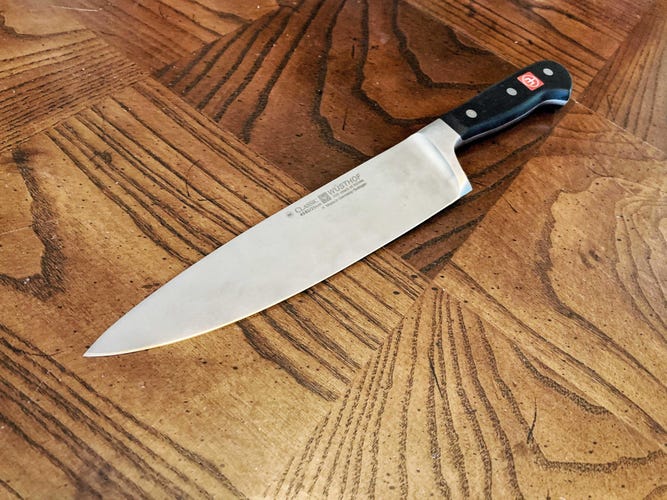
Why we like it:
German knife brand Wüsthof's 8-inch classic chef's knife is a workhorse in the kitchen. It's one of the weightiest knives I tested, which helps when chopping large amounts of uniform vegetables and cutting through robust foods like butternut squash without much exertion. The heavier knife weight helps guide the blade in uniform movements as you use it, but this Wusthof knife isn't so heavy that you ever feel controlled by the blade.
The Wüsthof classic is perfectly balanced between handle and blade and has a heel to protect your fingers, making it safer to wield. One of the best measures of how comfortable a knife feels in your hand is breaking down a chicken, as it requires many cuts across skin, meat, fat and cartilage. Using this blade for that task was as easy and natural as any other we tested.
Who is it for:
Top to bottom, this is one of the best available at a price that won't put you into debt. It's versatile and comfortable and its high carbon steel forged blade will keep a sharp edge as well as nearly any other knife -- Mac and Global excluded -- in this price range.
Who should avoid it:
This is a distinctly Western knife. If you need your chef's knife for more precise and delicate prep work, consider adding a Japanese-style knife to the mix alongside this, or choose a hybrid knife if you're only planning to buy one.

Pros
- Affordable
- Well balanced and easy to maneuver
- Lightweight and good for those with weak wrists or difficulty handling heavier knives
Cons
- Light knives give less guide when cutting
- A stamped blade won't last as long
What we like:
For its price, J.A. Henckels' Zwilling Gourmet 8-inch Chef's knife is a great budget option. It doesn't have the weight and heel of a heavier-duty knife like the Wüsthof or J.A. Henckels Classic but it's well-balanced and makes clean cuts on tomatoes and herbs, makes quick work of dicing onions and breaks down a chicken with relative ease.
Who is it for:
This is a great budget knife for a beginner chef seeking a Western-style blade. The Zwilling's cuts were consistently clean, and it felt comfortable in my hand. For around $80, I'd be more than happy to add this knife to my block.
Who should avoid it:
The Zwilling Gourmet is a stamped blade, rather than forged, which means it likely won't hold its edge as long. It's also lighter, which means your hand won't be guided quite as well through a tomato or similarly delicate food. It's also more difficult to get that steady rock for cutting through a mountain of vegetables.

Pros
- Longer blades are a pleasure once you learn to use them
- The hardest blade of any we tested
- Little to no resistance when cutting
- Stunningly beautiful
Cons
- Very expensive
- Longer blade, which comes with a learning curve
What we like:
I'll admit that I was intimidated by this knife when I first picked it up. It's more than 9 inches long and extremely sharp, but also very light, which makes it more difficult to control. That all spelled disaster for my sometimes clumsy and careless self. Miraculously, I didn't lose any fingers during my testing, and I started to fall for the elegant Aura. At times, it felt more like a weapon of combat than a kitchen tool.
The extra-long Japanese-style blade makes it extremely versatile and a great knife for trimming bigger pieces of meat and large vegetables like squash or even carving and slicing cooked meats. Breaking down a whole chicken with this knife was like carving butter, and I felt like I could do almost anything I wanted without resistance.
If you're worried about damaging the pricey knife, know that Auras sport the hardiest blades of any we tested, with a Rockwell hardness of 63.
Who is it for:
I loved the contoured handle made from stunning maple. It doesn't hurt that these knives -- which are handmade in California -- are small works of art. The cost is a bit of an eye-popper. But if you have above-average knife skills and are looking to treat yourself, this is a fun and beautifully made Japanese-style chef's knife to have at your disposal.
Who should avoid it:
This is not a knife for beginners or anyone who doesn't plan to care for their knife. It took me a little longer to get comfortable chopping and dicing vegetables, mostly because of the length, but after a few sessions, I got the hang of it. It's also prohibitively expensive for most people.
Recent updates
Aug. 2025
Made In's 8-inch chef's knife was retested and categorized as best overall chef's knife
The Global 8-inch chef's knife was retested and categorized as the best Japanese-style chef's knife
Korin's Tsuchime Hammered Damascus Gyuto was removed from the list
Several knives, including Cangshan's 8-inch chef's knife, Miyabi's Artisan chef's knife and Hammer Stahl's 8-inch chef's knife, were tested and considered for this list
Best chef's knives compared
| Knife | Style | Blade length | Weight | Hardness (Rockwell scale) | Edge angle | Price |
|---|---|---|---|---|---|---|
| Made In | Hybrid | 8.5 inches | 8 ounces | 58+ | 18 degrees | $129 |
| Global | Japanese | 8 inches | 7.8 ounces | 56-58 | 10-15 degrees | $120 |
| Mercer | Hybrid | 8 inches | 6.7 ounces | 53-54 | 15 degrees | $17 |
| Mac | Japanese | 7.9 inches | 10 ounces | 57-61 | 15 degrees | $155 |
| Wustof Classic | Western/German | 8 inches | 8.5 ounces | 58 | 14 degrees | $170 |
| Zwilling Gourmet | Western/German | 8 inches | 4.8 ounces | 57 | 15 degrees | $80 |
| Aura | Japanese | 9 inches | 6.9 ounces | 63 | 14 degrees | $850 |
How we test chef's knives
Our procedures involved five tests -- slicing tomatoes, dicing onions, mincing leafy herbs, chopping carrots and breaking down chickens -- each with a 1-to-10 rating, with more general use and observation. We wanted to approach the tasks as the average home cook would, focusing on general use and experience. We also avoided overemphasizing sharpness, as factory sharpness doesn't tell you much about a blade beyond its first few weeks or months of use.

Putting reps in on the chopping block was the best way for us to get a sense of any single knife.
You'll likely want to invest in a knife sharpener to get a sharp edge once you buy a chef's knife. Taking sharpening seriously is key to a knife blade's edge retention.
We took into account the type of steel used in the knife's construction (most are high-carbon steel), the method (whether it was forged or stamped), and the general design (full-tang knives, for instance, last longer than blades attached to a distinct handle).
Weight and balance
Despite what some advertising lingo might tell you, balance is not easily measured, nor is one balance point in a chef's knife necessarily better than another. Some knives we tested had too much weight concentrated in the handle for our liking, which can cause quicker hand and wrist fatigue. Beyond its measurable performance with various foods, we approached each knife as a package, experiencing how its weight and balance came together to create an experience that felt either intuitive or awkward.

Made In's 8-inch chef's knife had the most comfortable handle of the many we tested.
Handle comfort
This is another decidedly subjective category but we took careful note of each knife's handle shape and general comfort when gripped. Some knives sported handles with harder edges that felt less natural to grip. In general, more rounded handles won out when considering comfort, and Made In's ergonomic handle earned the top spot in this category.
The rest of the field: Other knives we tested

J.A. Henckels' Classic Chef's Knife looks similar to the Wusthof Classic but its slight differences in balance and design make it a much less enjoyable knife to use regularly.
This chef knife from the makers of the Swiss Army Knife gets a lot of love online for its value and construction but it's pricier than the Mercer and not quite as well balanced.
Cuisinart chef's knife: This $20 knife was just OK; there are better budget buys out there.
Material 8-inch chef's knife:Material's $105 full-tang chef's knife wasn't horrible but we didn't love the round handle.
J.A. Henckels classic: The butt of this $75 knife is heavier than it should be so prep gets tiring and mincing feels awkward.
Farberware 8-inch chef's knife: This cheap $10 knife was the worst of the bunch. It's so poorly balanced that we ended the chicken test midway for safety.
Cangshan's 8-inch chef's knife: This $120 Western-style knife had one of our favorite handles but didn't have enough weight to chop properly.
Miyabi's Artisan chef's knife:This $210 Japanese knife performed well but there were others in this price category we liked more.
Hammer Stahl's 8-inch chef's knife: Attractive as it is, something felt off with the balance of this $60 knife.
Homefavor chef's knife: No longer available.

Just a few of the chef's knives we tested.
A chef's knife can be your best friend in the kitchen, especially if you find the right fit. Take your time, figure out exactly what you need from your chef's knife and make an investment in quality. You could keep buying those generic $10 knives from the store every time your knife gets dull but if you're serious about upping your kitchen game, a high-quality chef's knife is one of the best investments you can make.
What to consider when buying a chef's knife
Choosing the right size
Most chef's knives have an 8-inch blade and that's a pretty safe bet if you're not sure what size to get. Depending on your skill level and the size of your hand, you might want a slightly longer or shorter blade for a good knife. There are chef's knives as short as 6-inches but you likely don't want to go shorter than 7-inches. You can also find blades as long as 9- or 10-inches, but those will be a bit more difficult to control and are not generally recommended for a beginner home cook.

The most common size for a chef's knife blade is 8 inches but there are plenty of larger and smaller knives available, too.
Consider the blade and handle materials
You can find chef's knife blades in alternative materials, including ceramic, but some composition of steel, often high carbon stainless steel, is the preferred material of 99.9% of knife makers the world over. For this list, we're only testing steel blades, of which there are a lot of different grades. In general, a softer steel blade will be easier to sharpen but may not last quite as long. For an amateur home cook, the difference in durability is negligible and the ability to sharpen it should take priority for a quality knife.
Blade hardness is measured using the Rockwell scale, a method for determining the hardness of materials, particularly metals, by measuring the depth of indentation caused by a controlled load on a specific indenter. While we didn't perform the Rockwell test on any of the blades, we've listed the Rockwell hardness of each and take them into account when making our selections.
The makeup of your knife handle is perhaps the more critical decision. Chef's knife handles are made from a wide range of materials, including wood, bone, carbon fiber and steel. Wood and certain poly blends may be a little softer to the touch. There are also handles with contoured and ergonomic shapes, while some -- namely Japanese knives -- feature a more linear design. Hence, an ergonomic handle will depend on your personal choice.

The materials from which your chef's knife is crafted are worthy of careful consideration.
Difference between forged and stamped knives
A forged knife is made from one block of steel while a stamped knife is punched out of a sheet of metal. Forged knives are traditionally sturdier and more expensive. I've read some hot takes that modern knife-stamping technology has caught up to forged models and that there's not as big a difference as there once was. I'll be honest, I can feel when I'm wielding a stamped knife versus a forged one. In general, forged knives seem better balanced and they're often (but not always) stronger, meaning they'll last longer and keep their edge better.
Knife style: Western (or German) knives vs. Japanese
German-style knives are generally heavier, with thicker blades and more pronounced bellies (the curve of the blade). This shape and weight are conducive to a rock chop motion which makes cutting large amounts of vegetables easier. German or Western knives are typically sharpened to a 20-degree angle, which makes them less prone to chipping.
Japanese steel knives are generally lighter with thinner blades, making them a bit better for intricate slices, trims and push-chops. While it's certainly not necessary, I like having one of each at my disposal to use for certain tasks. Japanese steel is usually harder on the Rockwell scale but their sharp angled edges make them more prone to chipping or breaking. These knives won't give you the steady rock chop you'll get with a Western-style knife so long bouts of chopping or dicing may feel like more of a chore.
Many modern knives combine elements of Western and Japanese knives -- known as hybrid knives. We recommend a hybrid knife for anyone who plans to own just one chef's knife to do all their kitchen prep. To help decide between these two styles or whether you might want both at your disposal, here's more on the difference between a Western and Japanese chef's knife.

A good, sharp chef's knife should slice through tomatoes with ease.
How heavy should a chef's knife be?
This really depends on personal preference, experience level and what you intend to do with the knife. In general, Japanese-style knives are lighter and thus better suited for very precise chopping, mincing, dicing and the occasional chiffonade. German-style chef's knives are often thicker and heavier and might be a better choice if you're doing more basic chopping and dicing or breaking down bone-in chickens and such.
Knives range from around 5 ounces to more than 12. If your wrist tends to tire easily when cooking, choose a lighter chef's knife under 7 ounces, whether it's Western, Japanese or hybrid.
Holiday buying advice for chef's knives
High-quality chef's knives can be pricey, so it's a good idea to take advantage of the ongoing holiday sales to snag them at a discount. Many people wait all year to buy chef's knives and other kitchen gear at holiday sale time, when you can get them at huge discounts. Chef's knives also make a great gift for the home chef or cooking enthusiast in your life. Having the right knife can make a big difference in the cooking experience, so it's a gift that will continue to bring them joy long after the holiday season.
Chef's knives FAQ
What is a chef's knife used for?
A chef's knife is the most versatile blade in your set. A chef's knife is used for the most common and laborious culinary tasks, including mincing, dicing and chopping vegetables, and trimming meat and fish. While some tasks like slicing soft tomatoes and bread or making small intricate cuts are best done with a serrated knife or utility blade, as much as 90% of knife work to complete most recipes can be done with a chef's knife. A sharp chef's knife can also be used for slicing cooked meats.
How do you sharpen a chef's knife?
There are several ways to sharpen a chef's knife, such as with a sharpening steel or whetstone. Many knife sets include sharpening steel, but if not, you can buy one for cheap. These methods both take a little training and practice but can be done by almost anyone. You can also use an automatic knife sharpener. You can find these in electric and manual models and they vary in price.
A third option is to have your knives professionally sharpened. A mail-in service called KnifeAid will do it for about $15 per knife with a minimum of four knives per order. We've used the service before and they do a great job.
Which knives do professional chefs use?
There are countless knife brands and many have earned the respect and endorsement of big-name chefs worldwide. German bladesmiths Wüsthof and J.A. Henckels are two of the most famous Western-style knife makers. Ina Garten is known to use a classic 8-inch Wüsthof chef's knife. Bob Kramer is a US-based knife maker who has had many famous chefs use his wares, including the late Anthony Bourdain.
Japanese-style knives are another category of chef's knives. These are typically lighter with a finer edge and are engineered for more meticulous knife work, including slicing sushi. Some of the most famous and respected producers of Japanese knives include Korin, Shun, Global and Miyabi. Bobby Flay is a reported fan of Shun Chef's knives.
What's the difference between a Western and Japanese knife?
The key differences between Western and Japanese knives come down to blade design, edge angle, weight and intended use. Western knives have a curved edge to encourage a rocking motion for chopping and extra weight to help power through dense foods and meat. Japanese knives have a straighter blade, sharper edge and lighter weight to help with precise cuts such as mincing, thin-slicing and filleting fish.
