

Want to improve your coffee experience but don't want to opt for drip coffee makers? A French press may be the right fit for you. French press coffee is considered to be richer and bolder in flavor, and it's surprisingly easy to make. There are plenty of French presses on the market, but you'll want to know which one is best in terms of material and what you'll need if you like your coffee iced.


After personally using and testing the top-selling best French press models, I've put together this guide for picking the best one for you. Here's what I learned on my quest to find the best French press after grinding pounds of beans and drinking scores of cups of joe.

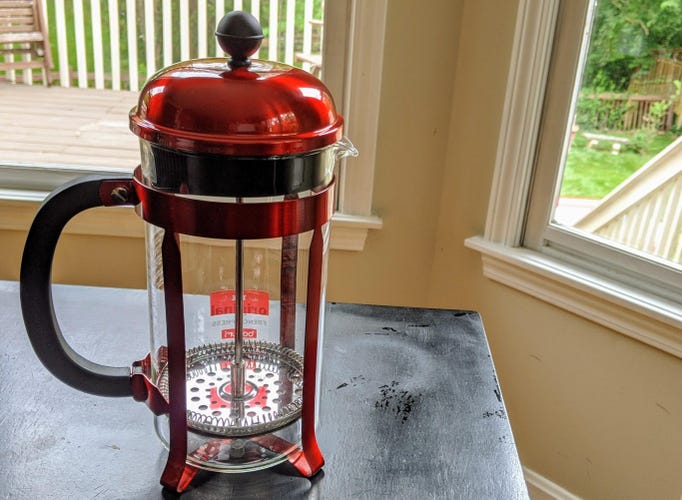
The Bodum Chambord has a classic French press design that hasn't changed much from when it first hit the scene in the 1950s. Despite that, this French press coffee maker model brews great coffee that's strong, well-balanced and richly flavored. It has a three-part stainless-steel filter and a glass carafe, and its steel parts also come in various finishes. I especially like the vibrant red version shown here.

For just about $20, the Bodum Brazil delivers hot coffee every bit as good as that made with the company's more expensive Chambord model. To cut down the price, Bodum uses plastic instead of steel for some of the coffee maker's parts. Its carafe, however, is borosilicate glass. The coffee I brewed in the Brazil was satisfyingly strong, yet balanced.

The most expensive model in this group, the Frieling stainless-steel press, doesn't come cheap. What you get for its steep price is a heavy stainless-steel press construction that's designed to last. Out of all the French press coffee makers I used, this stainless-steel French press felt the most durable by far. The stainless-steel carafe also has an insulated double wall that keeps coffee hot for hours.
Coffee I brewed in the Frieling came out well-extracted yet strong. So if money is no barrier, this is the French press for you.

The Veken French press is very well equipped considering its reasonable price. Inside the French press coffee maker kit you'll find various tools you won't see bundled with other coffee press models: a fancy wooden mixing spoon, a cleaning wand and a battery-powered milk frother for whipping up cafe-style drinks like lattes and cappuccinos.
I also like the elegant copper finish on this French press. It really sets it apart from other models I've seen. Most importantly, the Veken brews outstandingly delicious cups of coffee.

We put a bunch of French press coffee makers to the test to find out which were best.
How we test French presses
I test French press brewers much like I test standard drip coffee makers. I begin by hand-washing and hand-drying each product. Then I grind enough coffee beans to meet a specific brewing ratio. For French press brewing, that's 4 ounces of ground coffee to 32 ounces of water.

We test French press coffee makers the same way we test standard drip machines.
I then add hot water (203 degrees Fahrenheit, 95 degrees Celsius), or nearly boiling water, to the brewing chamber, stir the grounds and let them sit for 4 minutes. After that I drop the coffee plunger for each press and pour a sample cup. Next, I draw a sample of the brewed coffee and measure its percentage of total dissolved solids. I use a pocket reflectometer for this test. From there, I can calculate the extraction percentage for each batch of coffee I brew.
Ideally, the extraction percentage of brewed coffee should be in the range of 19% to 22%. Though this number alone doesn't guarantee delicious joe, it's a strong indicator of it. Ultimately, the truth lies in a proper taste test.
