Thanks to Android 4.0's newfound ability to take screenshots, we can bring you the inside look at Google's enormous Ice Cream Sandwich effort.
Jessica Dolcourt
Jessica is a passionate content strategist and team leader across the CNET family of brands. She leads a number of teams, including commerce, performance optimization and the copy desk. Her CNET career began in 2006, testing desktop and mobile software for Download.com and CNET, including the first iPhone and Android apps and operating systems. She continued to review, report on and write a wide range of commentary and analysis on all things phones, with an emphasis on the iPhone and Samsung devices. Jessica was one of the first people in the world to test, review and report on foldable phones and 5G wireless speeds.
Jessica began her leadership role managing CNET's How To section for tips and FAQs in 2019, guiding coverage of topics ranging from personal finance to phones to home. She holds an MA with Distinction from the University of Warwick in the UK.
Google's latest operating system is nothing short of overwhelming, once you take in changes large and small. Debuting with the Samsung Galaxy Nexus, we used the new built-in screenshots feature to walk you through some of the more prominent additions and enhancements. There are many more that you'll discover in these photos, and others that we've also explored in the full review.
2 of 28Screenshot by Jessica Dolcourt/CNET
Hail to Honeycomb
Ice Cream Sandwich (ICS for short), splices Honeycomb with redesigned elements that are familiar to Android's smartphone users, like this navigation control to pull up most recently accessed programs. (Read the full Samsung Galaxy Nexus review.)
3 of 28Screenshot by Jessica Dolcourt/CNET
Notification bar
Google's redesigned notification bar is gorgeous and sleek. You wouldn't know by looking at it, but you can use gestures to swipe away alerts when you're done. (Read the full Samsung Galaxy Nexus review.)
4 of 28Screenshot by Jessica Dolcourt/CNET
Apps and widgets
The app tray resembles the old, with the exception of a few details, like the horizontal rather than vertical sliding, some graphical transitions, and the addition of a new content type to drag to the home screens: widgets. (Read the full Samsung Galaxy Nexus review.)
5 of 28Screenshot by Jessica Dolcourt/CNET
Widgets
These widgets used to live in a hidden menu you got by long-pressing the home screens. This is a better home for them, but the layout looks cluttered. (Read the full Samsung Galaxy Nexus review.)
6 of 28Screenshot by Jessica Dolcourt/CNET
Resizeable
Most widgets are resizable on all ICS phones. Press and hold to select them, then grab and drag the handles. (Read the full Samsung Galaxy Nexus review.)
Using facial recognition software to unlock the phone is one of the most buzzed-about features in ICS. You access it from the Settings menu. (Read the full Samsung Galaxy Nexus review.)
9 of 28Jessica Dolcourt/CNET
Unlock
Stick your face in front to set it up, and also to unlock. Yes, a photo will unlock it too, or your doppelganger, so other measures are better for your actual security from peeping eyes. (Read the full Samsung Galaxy Nexus review.)
10 of 28Screenshot by Jessica Dolcourt/CNET
Backup
If your face fails you, you can select either a pin or traceable pattern as backup. (Read the full Samsung Galaxy Nexus review.)
11 of 28Screenshot by Jessica Dolcourt/CNET
PIN lock
Some companies' IT departments require a PIN, which will disable Face Unlock. (Read the full Samsung Galaxy Nexus review.)
12 of 28Screenshot by Jessica Dolcourt/CNET
Call screen
It's new, it's pleasantly blocky, and it makes use of photos--if you've got 'em. (Read the full Samsung Galaxy Nexus review.)
13 of 28Screenshot by Jessica Dolcourt/CNET
Incoming call
Here's what the screen looks like when someone calls. Drag the glowing icon to answer, hang up, or text the caller. (Read the full Samsung Galaxy Nexus review.)
14 of 28Screenshot by Jessica Dolcourt/CNET
More than calling
Tap a contact's image to quickly send messages, an e-mail, or launch a phone call. (Read the full Samsung Galaxy Nexus review.)
15 of 28Screenshot by Jessica Dolcourt/CNET
Texting
Easily dial, attach things, or access the menu (the three dots) from the text composition screen. (Read the full Samsung Galaxy Nexus review.)
16 of 28Screenshot by Jessica Dolcourt/CNET
Attach stuff
A closer look at some of the things you can now very effortlessly attach to a text. Similar context menus also apply to e-mail. (Read the full Samsung Galaxy Nexus review.)
17 of 28Screenshot by Jessica Dolcourt/CNET
Sharing photos
Tap a pic after you've taken it to easily share in a ton of ways. (Read the full Samsung Galaxy Nexus review.)
18 of 28Screenshot by Jessica Dolcourt/CNET
Editing tools
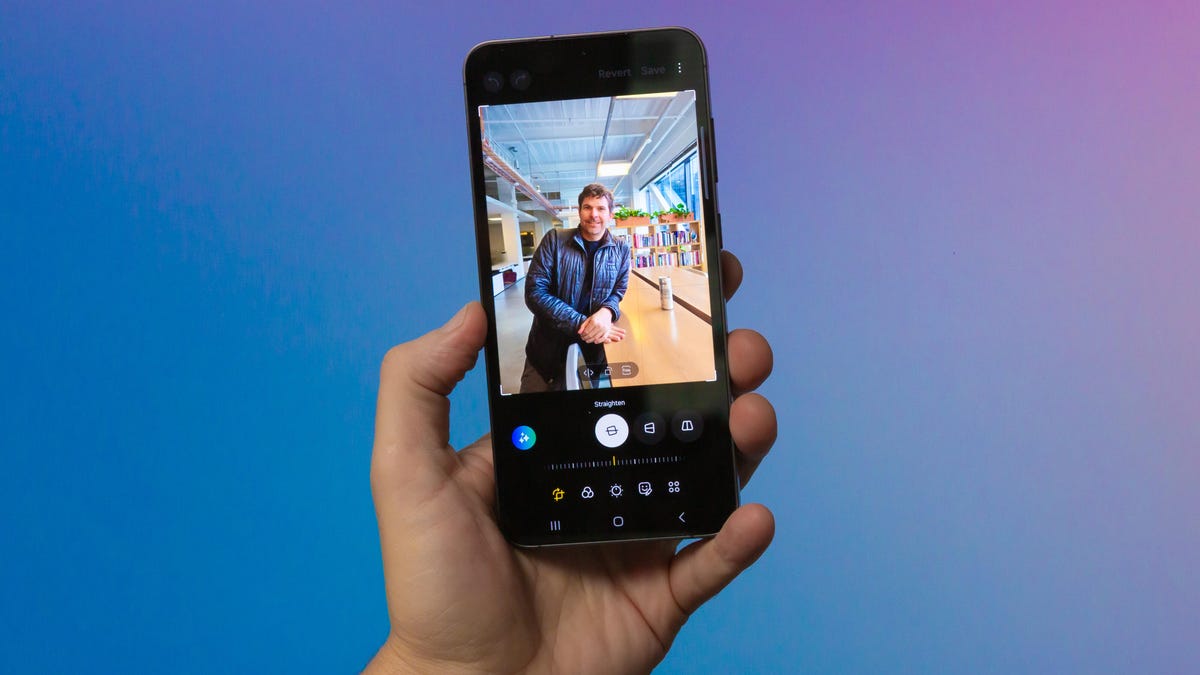
In the Gallery, tap again to crop, straighten, adjust color, and add effects. (Read the full Samsung Galaxy Nexus review.)
19 of 28Screenshot by Jessica Dolcourt/CNET
Panorama
The new panorama mode is cool, but it isn't novel and we're not sure it needs to be called out as a mode. Still, it worked pretty well. (Read the full Samsung Galaxy Nexus review.)
Google went all out safeguarding your grammar and spelling. Tap a word in the predictive text ticker to get more options if you don't see the one you want. (Read the full Samsung Galaxy Nexus review.)
25 of 28Screenshot by Jessica Dolcourt/CNET
Word replacement
ICS will still replace words for you, but you can also tap an unknown word to correct a misspelling or add a word to the dictionary. (Read the full Samsung Galaxy Nexus review.)
26 of 28Screenshot by Jessica Dolcourt/CNET
Easter egg time
Repeatedly press the Android version number in the settings for a reward--of sorts. (Read the full Samsung Galaxy Nexus review.)
27 of 28Screenshot by Jessica Dolcourt/CNET
Data usage
Google has added an entire section to the Settings menu to help you monitor data usage. Before, you'd need a third-party app to track this level of detail. (Read the full Samsung Galaxy Nexus review.)
28 of 28Screenshot by Jessica Dolcourt/CNET
Android Beam
You'll use Beam, which relies on the radio frequency standard NFC, to share things like maps, contacts, and an app page in the Android Market (for instance, use Beam to "share" a game or app). NFC and Android Beam both need to be enabled. Find them in the Wi-Fi settings menu under "More".) (Read the full Samsung Galaxy Nexus review.)