
There's a new breed of MacBook in town, and as you're about to learn, it's more attractive, more powerful and more expensive than previous models. The new design has much in common with the aluminium-swathed MacBook Pro in design, but sports a smaller 13.3-inch screen. Prices start at £949 for the entry-level MacBook, up to £1,149 for the slightly enhanced version. The previous MacBook -- now known as the white MacBook -- can be bought for £719. All are available now from the Apple Store.
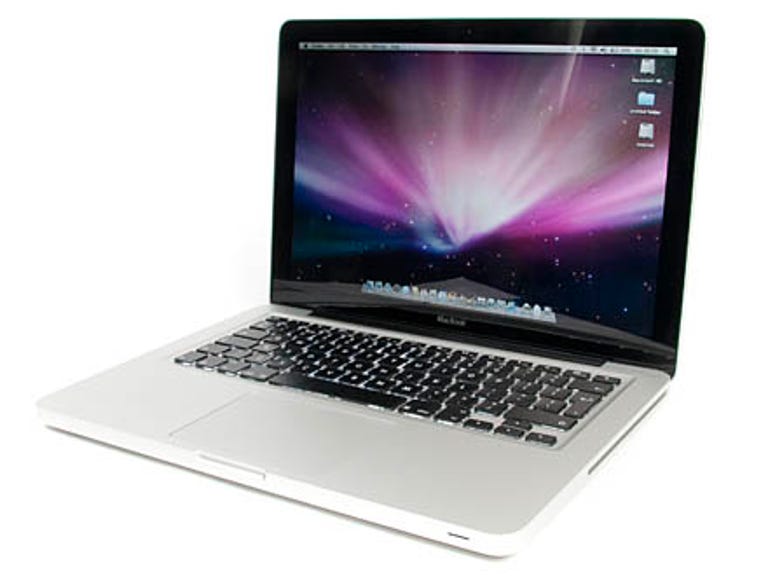
Apple MacBook (aluminium 2008 edition)
The Good
The Bad
The Bottom Line
Design
The new MacBook is as attractive and as desirable as you'd expect from a new Apple product. Before we'd even extracted it from the packaging -- which Apple says contains less wasted materials than ever -- a crowd of CNET's finest had huddled around it.
Who could blame them? The new MacBook looks like a curious hybrid of the previous MacBook Pro and the MacBook Air. It is, we're told, carved from a solid block of aluminium, which is lovingly hollowed out before all the high-tech gubbins are placed inside. All that metal means the MacBook is a fairly heavy beast. It tips the scales at 2.04kg, but that -- believe it or not -- is actually lighter than its 2.14kg predecessor.
The MacBook's lid is as understated as ever. Just a lone, backlit Apple logo takes centre stage. Lift the lid -- the catch is magnetic -- and you're greeted by a silver and black colour scheme that's very easy on the eye. Most of the system is a silvery aluminium, while the keyboard buttons and screen bezel are black. Unlike Windows PCs, there are no unsightly stickers declaring how much RAM is installed, or what type of CPU is inside. The 'MacBook' logo below the screen says it all.
Apple is always bleating on about how easy its machines are to use, and the latest MacBook benefits from this philosophy. The keyboard is exceptionally comfortable and is backlit so the letters automatically illuminate in the dark. The mouse trackpad meanwhile, is now 39 per cent larger than on previous MacBooks and is made from glass, so it feels fantastically smooth to the touch. As before, it's gesture-sensitive, so you can make pinching and stretching motions to zoom in or out -- and there's a new four-finger upward swipe action that launches Expose.
There are no selector buttons below the trackpad. That's because the entire trackpad can be used as a button. You can't tap it, but you can physically push down until you feel it give slightly, as a membrane below the pad registers your touch. It feels a little unusual to begin with, but it soon begins to make perfect sense -- and the fact your thumb isn't permanently poised over a button may even reduce the chances of repetitive strain injury. Right clicks are registered by pressing down with two fingers. If this is too annoying, the trackpad has programmable hot zones, so you can assign a specific spot as your right click area.
All the MacBook's input ports are logically arranged on the left side of the laptop. Running from back to front, there's a MagSafe AC power connector, two USB ports, a DisplayPort video output, audio line-in and line-out, and a Kensington lock for securing the laptop to a desk. Just ahead of that is a neat battery-level indicator. Previously, this could be found on the underside of the laptop, but bringing it up to the side makes it much easier to see.
Speaking of the underside, we were somewhat surprised to find a removable battery hatch. Flip the catch just in front of it and you'll have access to the battery and -- if you've got a screwdriver handy -- the hard drive.
Features
The MacBook will ship in two guises -- an entry-level unit costing£949, and a more advanced model costing £1,149. The entry-level machineuses an Intel Core 2 Duo CPU running at 2GHz, 2GB of DDR3 RAM and a160GB hard drive. That, we're not ashamed to say, is not good enough,given how much of your money Apple is asking for.
Apple has switched allegiances from ATI to Nvidia for its graphicshardware. The entry-level MacBook comes equipped with an Nvidia GeForce9400M graphics card, a very solid card that allows smooth frame ratesin all but the most demanding of games. It's not as potent as the 9600MGT in the new MacBook Pro, but it'll certainly do.
It's hard not to talk about the MacBook without mentioning its13.3-inch widescreen display. This has a native resolution of 1,280x800pixels, is LED backlit and produces absolutely fantastic image quality.The only letdown is the fact it comes with a glossy coating on theouter panel, which essentially turns it into a mirror whenever it comesinto contact with direct light.
The only difference between the entry-level MacBook and its moreexpensive sibling is that the latter sports a faster 2.4GHz CPU and alarger, 250GB hard drive. We're not convinced this is worth the extra£200, but if you're unaffected by the credit crunch, who are we to putyou off?
Both MacBooks can be customised at the time of purchase. Up to 4GB ofmemory can be installed, and they'll accept hard drives as large as320GB. A 128GB solid-state drive is available for a jaw-dropping £420.Software includes Time Machine for creating backups, Mail, iChat, theSafari browser, Photo Booth, Front Row, Boot Camp (for installingWindows XP in addition to OS X), and the iLife '08 suite.
Performance
You'll be hard pressed to find a Core 2 Duolaptop -- Windows-based or otherwise -- that isn't fast. Obviously, ourPCMark 2005 benchmark won't run on a Mac, but anecdotal testing yieldedsome positive results. Our review sample uses the faster 2.4GHz CPU and2GB of RAM, and with this, the system booted in approximately 30seconds and zipped convincingly through day-to-day applications. Evenwhen multitasking with iTunes, Safari and iPhoto, the system neverbatted an eyelid. It also stayed cool to the touch -- even afterprolonged use.
Graphics performance is vastly improved on previous models.Overall, Apple claims video performance is 6.2 times faster than onprevious models. The new Nvidia cards are also compatible with Nvidia'sCuda technology. This enables programmers to write software thatutilises the processing power of the graphics card as well as the CPUto solve complex computational problems. Video transcoding incompatible applications, for example, is significantly faster throughCuda, as is image manipulation in the latest version of Adobe CS4.
We're still in the process of testing the MacBook's battery life, butApple claims customers can expect approximately 5 hours -- even withthe wireless adaptor enabled. We find that difficult to believe -- 3hours is more likely -- but we'll update this review with anindependent battery score in the next day or so.
Conclusion
The new MacBook is, as we all expected, very goodbut very expensive. We can see where all the money is going, though --it's an absolutely gorgeous piece of engineering that you'll spendhours just looking at. If you've got the cash, we'd thoroughlyrecommend it. If not, you'll get more for your money buying a Windowsmachine.
Edited by Nick Hide