


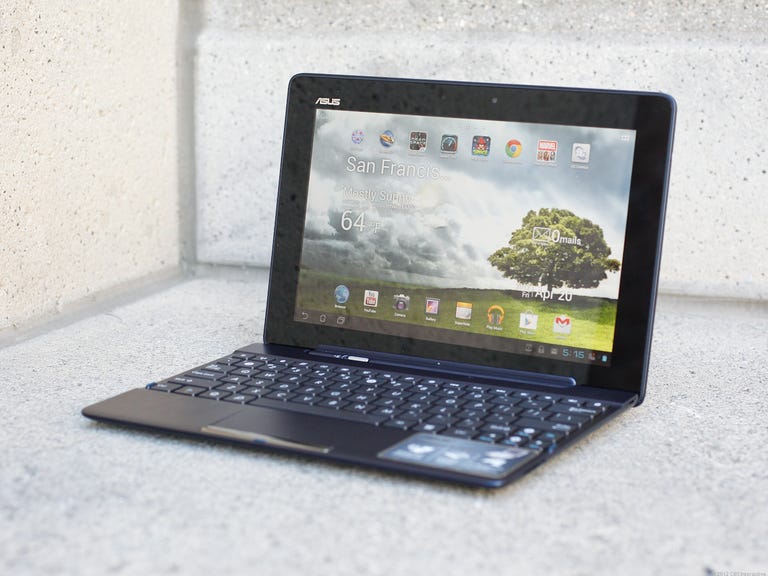
Asus Transformer Pad TF300
The Good
The Bad
The Bottom Line

For Android tablet fans, the Asus Transformer Prime TF201 represented that moment when they could say to their iPad 2-toting buddies: "Hey! I have something thinner, lighter, and -- at least on paper -- more powerful than you do. Also: keyboard! Ba-bam!"
Well, there's the possibility it didn't go quite like that, but I think you get my point.
Still, the Prime had some GPS issues and its Wi-Fi speed wasn't as high as some expected. And by "some," I mean me. Also, starting at $500, it wasn't exactly cheap.
Enter the Asus Transformer Pad TF300 Series. The TF300 starts at $380 for 16GB of storage, comes with Android 4.0.3 installed, replaces the Prime's metal unibody with plastic, lowers the speed of its Tegra 3 processor, and removes the flashlight from the rear 8-megapixel camera.
Are those changes enough to diminish the enthusiasm tablet enthusiasts should have for this new tablet? I'll give you a hint: No.
Design
Again, if you took the Transformer Prime TF201, added a few millimeters of girth, replaced its aluminum unibody with plastic, and made it slightly heavier, you'd essentially have the Transformer Pad TF300. There are a few other design differences, but those are the basics.

The TF300 measures 0.38 inch thick -- compared with the Prime's 0.32-inch thickness -- and the plastic outer shell doesn't feel quite as sturdy or as full as the Prime's metal body does. Those differences are readily apparent (although the TF300 is still relatively thin compared with most tablets); however, without using a scale, I initially had trouble discerning which was heavier. In fact, the TF300 weighs 1.4 pounds, 0.08 pound more than the Prime.
| Balance mode | Peformance mode | Power saving mode | |
|---|---|---|---|
| Asus Transformer Pad TF300 (with dock) | 13 | 12.2 | 13.2 |
Here are the battery test results (in hours) for the TF300 as a standalone tablet without the mobile keyboard dock.