


For 2014, Bowers & Wilkins has done something interesting with a couple of its headphones, the on-ear P5 and the in-ear C5 we're reviewing here. Instead of coming out with completely new versions of the headphones, it left their exterior designs virtually unchanged and instead tweaked the headphones' innards to improve the sound quality.
Bowers & Wilkins C5 S2
The Good
The Bad
The Bottom Line
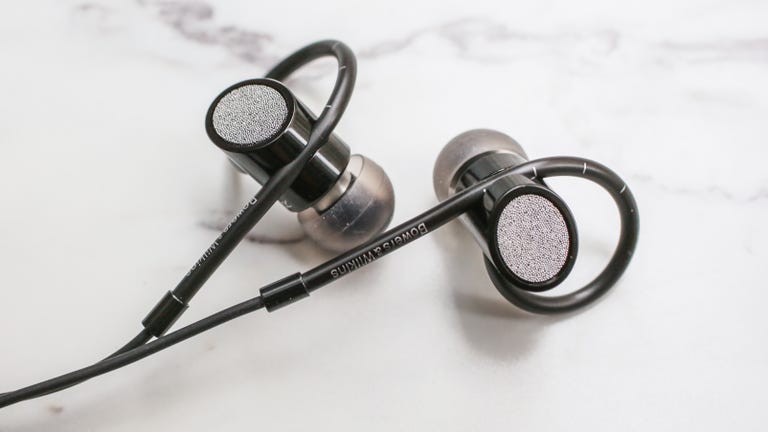
To differentiate the new from the old , the Series 2 ($179.99, £149.99, AU$249.95) has an all-black design (the original had a translucent cable cover that revealed the silver cable inside). There's also been some slight modifications to the eartips (for the better), with a "subtly different grade of rubber and slightly altered geometry," according to Bowers & Wilkins' head of engineering. And the body now has a "radius at the end rather than a sharp edge to improve comfort as in some users this area can touch the skin."
The headphone retains its signature Secure Loop, which is "infinitely" adjustable and helps secure the headphones in your ear. It should work well for most people, but it won't be everyone's cup of tea (with some ears, it may put a little too much pressure on the lower part of the ear). I (David) found it more comfortable this go round, but Steve wasn't as enamored of the design.
As I said with the original C5 model, kudos to the designers behind the headphone. It exudes a high-end quality of design with an artful tungsten/aluminum finish and features a seemingly sturdy build quality. Though we prefer an L-shaped plug to the standard slim one found at the end of the C5, its slim nature makes it easy to use with smartphones covered by a protective case.
The key to any in-ear headphones is getting a tight seal, and to that end, B&W has included a few different eartips in the box, the largest of which fit our ears best. You also get a half-moon-shaped protective carrying case, which works well, and an Apple-friendly inline remote and microphone for making cell phone calls. Not all of the remote's functions will work with Android and Windows phones, but you can use the microphone to make calls with any phone, and call quality was decent.
Performance
Before we checked out the C5 Series 2 we reacquainted ourselves with the original C5. Just as we remembered, the sound was rich and warm, but not lacking in detail until we compared them to the C5 Series 2.
The differences weren't subtle -- the old C5 still sounds sweet, but the C5 Series 2's clarity gains are substantial. Not just in the midrange or treble, the C5 Series 2's deeper and clearly articulated bass lets you more easily follow what's going on down there. (We recently heard similar improvements in the P5 Series 2 on-ear headphones).
The C5 Series 2 is a real treat with great live recordings, like Van Morrison's "Too Late To Stop Now." The sense of being there at the concert is more apparent over the C5 Series 2 than the original C5.

We brought the Hifiman RE-400, an affordable in-ear headphone with an audiophile sound signature, into the mix. With the C5 Series 2, the bells opening Brian Eno's tune "Quartz" have just the right amount of sparkle and shimmer. Over the Hifiman RE-400 the sound thins out and takes on a rougher edge.
With Daft Punk's "Motherboard" the growling bassline that went unnoticed over the RE-400 was given its full due over the C5 Series 2, and the stereo imaging opened up, so the sound feels less stuck inside your head (in general, the C5 Series 2 has a nice, open quality).
The only real downside to the headphone is that since its key strength is its clarity, it can reveal too much of the harshness of less-than-stellar sounding MP3s. But by the same token, that clarity is a big asset with great-sounding recordings.

Conclusion
While the Secure Loop system may not be a perfect fit for everyone, Bowers & Wilkins has taken an already very good sounding headphone and made it sound even better. It's one of the best sounding sub-$200 earphones you can buy and well worth a long look if you're looking for a high-quality, stylish headphone at a midrange price.