


The Canon PowerShot A580 is a friendly 8-megapixel point-and-shoot camera. It has a £100 price tag, cheerful styling and runs off AA batteries: all of which make it a family or novice-friendly digital snapper. But beneath the cuddly exterior, is there a camera that deserves to be taken seriously?
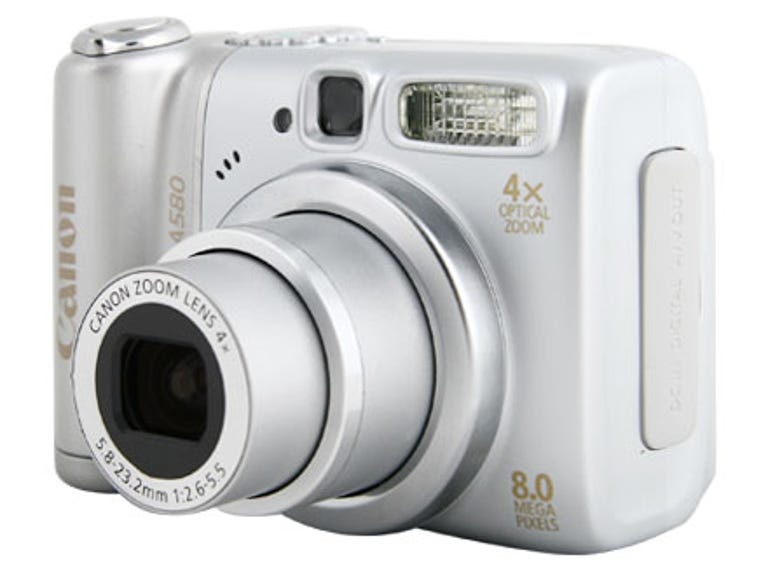
Canon PowerShot A580
The Good
The Bad
The Bottom Line
Design
The blocky PowerShots are at the far extreme of design when compared to the sleek, glossy IXUS range. The cute design and plastic body gives the chunky A580 a toy-like appearance, but we're not keen on it. The rounded buttons and exaggerated curves have a hint of cheapness and we wonder who will find the design appealing. The frame has no flex or creakiness despite the plasticky feel, so it's sturdy.

Bulbous, clearly-labelled buttons control the camera with a Func button to provide quick access to shooting options. The mode dial, which offers common scene modes and manual or automatic settings, makes an initially satisfying, later annoying clicking noise when turned, but at least it goes around 360 degrees in both directions.
The 64mm (2.5-inch) LCD screen is joined by a dinky round optical viewfinder, which lets you switch off the screen to preserve battery life. The viewfinder chops a strip of the sides and bottom off the frame -- known as parallax error -- so you should be careful when composing shots.
One subjective concern that some may not even notice was that the zoom rocker -- a collar switch on the camera's shoulder -- was at a very slight angle that made it less comfortable to use.
Features
The A580's specs and feature set are as vanilla as its styling. The imaging is handled by a relatively small 1/2.5-inch CCD sensor. The lens has a 35mm-equivalent focal length of 35-140mm, which isn't especially wide, but is a slightly longer than usual 4x optical zoom. Image stabilisation is built in to the lens and orientation sensor works out which way round the picture was taken.
Additionally, a 9-point TTL autofocus also uses face detection to focus on and set exposure for faces spotted in the frame. You can also select a face and track it as they move around. There are 16 shooting modes including automatic mode with options like portrait and landscape on the mode dial and less commonly-used options like beach and foliage in the menus. One impressive feature is a 15-second long shutter, which can be used to create interesting night shots.
Red-eye features can pre-fire an orange flash and/or remove red eyeautomatically as you snap or manually in playback mode. In playback,images can be tagged or more accurately filed into preset categories. You can choose people and scenery categories as well as three usercategories. This makes sorting pictures easier and allows forslideshows showing just the pictures you want.
Movie modes include VGA resolution at 20 frames per second, acompressed long play setting and a 30fps option at half VGA resolution.A 4GB SD card holds 49 minutes of VGA footage, 95 minutes on long playand 91 minutes of half-size video. Canon compacts do not includeonboard memory, which we don't mind as internal memory is laughablymeagre in most cameras, although bundling a paltry 32MB SD card ispretty pointless.
We also felt that, as so often happens on lower-end compacts,the manual mode is misnamed. You don't even get shutter or aperturepriority modes.
Performance
Despite the impression the cheery -- and to our eyes, slightlycheap -- styling gives, this is not a bad camera. It's a Canon afterall and image quality is unlikely to be the weakest link. Barreldistortion at the wide end is present, but purple fringing is kept wellunder control.
Our only real concern is that images are soft. The lack ofoptical image stabilisation means that hand-held snaps -- the A580'sbread and butter -- aren't as crisp as they could be. It's worthsharpening images in post-processing, but that's a matter of taste.
The lack of image stabilisation also leads to the A580's quicklyresorting to higher sensor sensitivity when the light is anything butperfect. Predictably, images taken at the highest ISO setting of 1,600were unusable: noise showed up even at ISO 400 and 800.
Turning it on takes less than two seconds and it boasts arespectable 1-second shot-to-shot time. Unlike all too manycontemporary compacts, the A580's continuous mode is not limited tothree shots. It seemed happy to snap away indefinitely at just over oneframe per second, but our gratification at this was tempered by theannoying ticking noise it made and the fact that the supplied batterieswere reduced to flashing red status in just over two minutes.
Conclusion
Puppy-dog styling and an anonymous feature set leave the CanonPowerShot A580 feeling short of personality. Cameras from the IXUS orLumix ranges, such as Panasonic Lumix DMC-FS5,are much sleeker and more innovative, if more expensive. If you'rereally keen on a chunky snapper and your heart is set on AA batteries,the Kodak EasyShare Z712 IS packs a 12x zoom and twice the panache.
Edited by Shannon Doubleday