


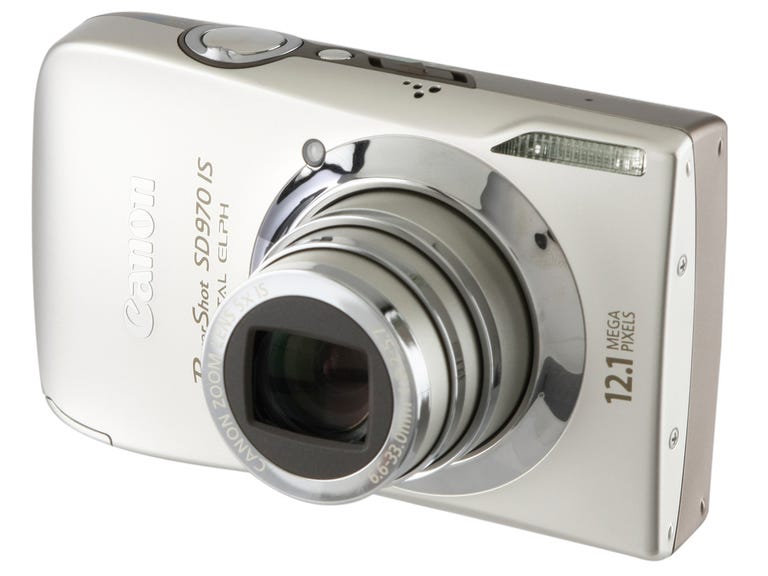
A 5x zoom lens and a 12-megapixel resolution isn't much to get excited about these days. Jam them into a somewhat unattractive compact body and they become even less of a reason to drop nearly $400 on a point-and-shoot camera. That's what's wrong with the Canon PowerShot SD970 IS. It does take a very good photo, but so do many of Canon's Digital Elphs. It's a nice enough camera, but not a standout in the company's crowded ultracompact lineup.
The Good
The Bad
The Bottom Line
| Key specs | Canon PowerShot SD970 IS |
| Price (MSRP) | $379.99 |
| Dimensions | 3.7 inches wide by 2.2 inches high by 1 inch deep |
| Weight (with battery and media) | 6.6 ounces |
| Megapixels, image sensor size, type | 12 megapixels, 1/2.3-inch CCD |
| LCD/Viewfinder | 3-inch LCD, 461K dots; n/a |
| Lens (zoom, aperture, focal length) | 5x, f3.2-5.8, 37-185mm (35mm equivalent) |
| File format (still/video) | JPEG/MOV (H.264) |
| Highest resolution size (still/video) | 4,000x3,000 pixels/1,280x720 at 30fps |
| Image stabilization type | Mechanical and electronic |
| Battery type, rated life | Lithium ion rechargeable, 270 shots |
The silver-and-gold SD970 is a little boring compared with other models in Canon's point-and-shoot lineups. The body and control design of the SD970 may be new, but it's similar to another Digital Elph model, the SD880 IS. You get two buttons for playback and printing (though the latter is programmable) at the top, in the middle is a scroll wheel surrounding a four-way directional pad centered with a Func/Set button, and below that are Menu and Display buttons. It works well, but the SD880 IS' controls look and work better. However, that camera's LCD has half the resolution of the SD970's noticeably superior display.
In general, the camera is simple to operate, though its outward appearance may have you thinking otherwise because of all the labels and buttons. The biggest hurdle is Canon's revamped context-sensitive shooting menu reached by hitting the Func/Set button. It looks good, but takes some getting used to, especially if you're upgrading from an older Canon PowerShot.
One of the biggest issues with this model is its lens. Yes, you get a little extra zoom for a pocket camera, but it's slow with a maximum aperture of f/3.2 and fairly narrow at 37mm. These specs would be more forgivable if the price on the SD970 wasn't so high; but it is, so they're not.
| General shooting options | Canon PowerShot SD970 IS |
| ISO sensitivity (full resolution) | Auto, 80, 100, 200, 400, 800, 1,600 |
| White balance | Auto, Daylight, Cloudy, Tungsten, Fluorescent, Fluorescent H, Custom |
| Recording modes | Smart Auto, Program/Scene, Movie |
| Focus | Center AF, Face AF, Servo AF |
| Metering | Evaluative, Center-weighted, Spot |
| Color effects | Vivid, Vivid Blue, Vivid Green, Vivid Red, Neutral, Sepia, Black & White, Positive Film, Lighter Skin Tone, Darker Skin Tone, Custom |
| Burst mode shot limit (full resolution) | Continuous unlimited |
If it seems like this review sort of contradicts the overall rating, there's a reason for that. Technically, there is nothing horribly wrong with the Canon PowerShot SD970 IS. It is a very good camera. It's just that for the money, there are better options out there, including models from Canon, Sony, Panasonic, and Nikon.
(Shorter bars indicate better performance)
 | Time to first shot | | Typical shot-to-shot time (flash) | | Typical shot-to-shot time | | Shutter lag (dim) | | Shutter lag (typical) |
(Longer bars indicate better performance)
Find out more about how we test digital cameras.