


After an initial wave of Windows 8 laptops with sliding, twisting, folding, or detachable screens, we're now seeing a small flood of pure standalone slate-style tablets with Microsoft's new operating system. These systems often include a keyboard and touch pad/mouse component, but it's secondary to the tablet experience.
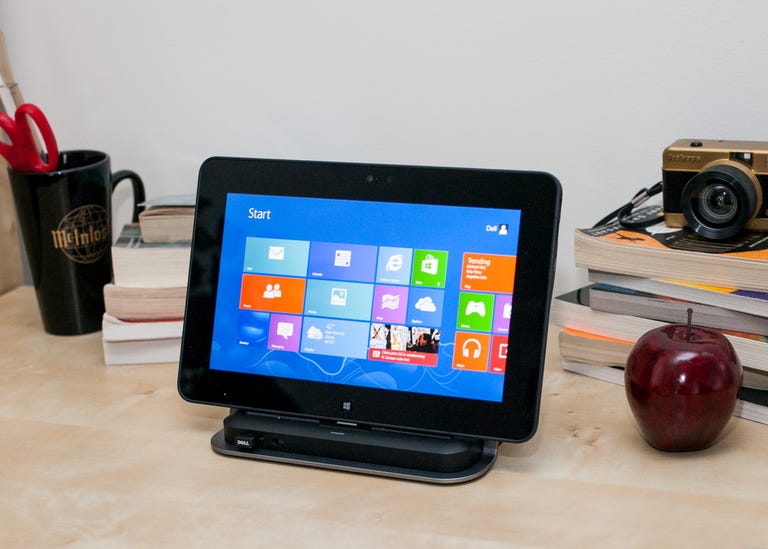
Dell Latitude 10
The Good
The Bad
The Bottom Line
Most prominent of these new Windows 8 tablets is the Core i5 Microsoft Surface Pro, which is more than $1,100 with a full 128GB solid-state drive (SSD) and its cool, clever keyboard cover. Other Intel Core i5 models include the Acer W700 and the Samsung Series 7 Slate 700T; all of these perform much like a current-gen ultrabook.
The other major fork in the tablet road uses Intel's low-power Atom CPU for a thinner, lighter, less expensive system, and one that in most cases has far better battery life than Core i-series tablets or laptops. The Acer W510, Lenovo ThinkPad Tablet 2, and Dell Latitude 10 all fall into this category.
For as little as $500, these Atom tablets offer a very similar experience to the more expensive models, with some serious limitations to keep in mind. First, as in the case of the Dell Latitude 10 reviewed here, the starting price may be nowhere near what you end up once you've added the features you need. For the Latitude 10, $499 gets you the Essentials version of the system, with a nonremovable battery and only a 32GB SSD, and lacking corporate extras such as a TPM chip. Our review unit was the $649 base model, with the 1.8GHz Intel Atom Z2670 CPU, 2GB of RAM, and a still-small 64GB SSD.
For an extra $100, we also received the Dell Latitude 10 dock, a solid metal docking station that adds four more USB ports, an Ethernet jack, and HDMI and audio outputs. Missing, however, was any tablet-sized Dell keyboard or keyboard case. Your only options are a clunky full-size wireless keyboard and mouse set, or a third-party keyboard case from Kensington. There's nothing along the lines of the excellent Microsoft keyboard cover that works with the Surface Pro.
While Intel's Atom carries a lot of historical baggage from the best-forgotten Netbook era, the Windows 8 UI feels smooth and responsive on the Latitude 10. In general, official Microsoft Windows 8 apps, such as IE10, were clearly optimized for the Atom, but third-party apps, including the Chrome Web browser, were stuttery, revealing the limitations of the Atom.
The Latitude 10 is targeted at business users (although the basic $499 model aims more at budget consumers). With that in mind, it may be a good match for your corporate tablet needs, especially if they don't involve running high-stress apps or storing a lot of large files locally. But at prices that aren't far off from midrange Core i-series ultrabooks with 500GB hard drives or 128GB SSDs, the combination of the Latitude 10 plus a dock and a keyboard feels expensive for the Atom experience.