


The Helix is a well-made but expensive product that presents an interesting question. While there very well may be a market for an 11-inch hybrid with an emphasis on business and security features and a body leaning toward the industrial, rugged side, exactly what sort of premium should one expect to pay for it?
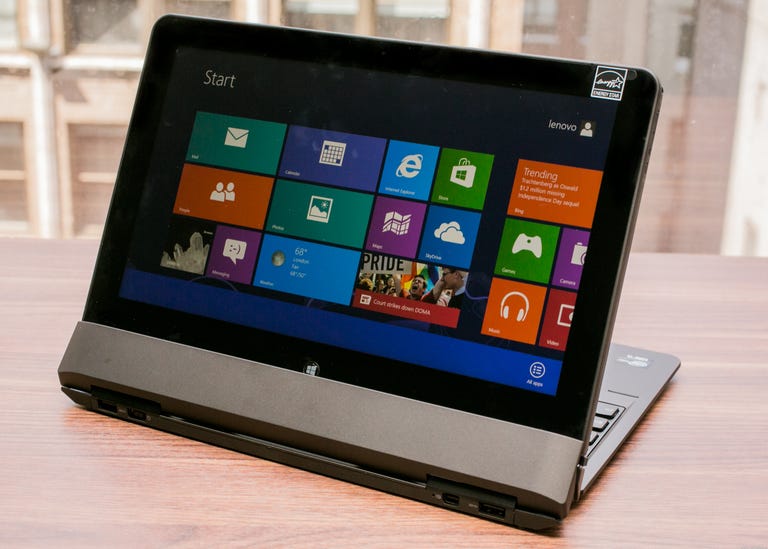
Lenovo ThinkPad Helix
The Good
The Bad
The Bottom Line
When it was first introduced at CES 2013, Lenovo described the Helix laptop-tablet hybrid as a "flip-and-rip" system, which sounded like the usually staid company was trying to add a little sizzle to the normally conservative ThinkPad lineup.
In person, this detachable-screen hybrid still has a very ThinkPad-like look and feel, and from a distance, it looks nearly identical to the army of ThinkPads on office and cubicle desks around the world.
The flipping and ripping comes into play when you activate the small hinge-based latch for removing the display from the rest of the body. In this case, the screen pops off much like any other hybrid's, but then can reattach after being rotated 180 degrees, leaving the screen facing out from the back of the system. That makes for a good presentation mode, which I sometimes call a "kiosk" setup. Of course, you can also use the Helix screen by itself as a Windows 8 slate, or fold the unit shut with the screen facing out for a thicker tablet mode backed up by the extra battery power of the keyboard dock.
But as an 11-inch laptop, the Helix is in the middle of a suddenly crowded market. The Sony Vaio Pro 11 and 11-inch MacBook Air are on the traditional clamshell side, while Lenovo's own IdeaPad Yoga 11S and the Acer Aspire P3 are hybrids, although ones that work differently than the Helix.
Another potential stumbling block: the Helix (like the Yoga 11S) is currently stuck with Intel's previous-generation processors, rather than the new fourth-generation Core i-series, called Haswell. The difference is important for a device such as this, because the battery life numbers we're seeing from the first few Intel Haswell laptops make the new chips more than worth waiting for, especially if you're going to be using a hybrid in its extra-portable tablet mode. The Helix ran for an acceptably long time when both the base and screen batteries were used together, but for pure tablet use, it's tempting to wait for an updated version.
Because this system is from Lenovo's professional-grade ThinkPad line, as opposed to the consumer-targeted IdeaPad line, you can expect to pay a bit of a premium compared with other machines with similar specs. For a ThinkPad's rigid construction, best-in-class keyboard, and IT-friendly security features, that's perfectly reasonable, in theory. But, the Helix starts (starts!) at a frankly surprising $1,679 -- and for that, you get only a last-gen Intel Core i5 CPU, 4GB of RAM, and a 128GB solid-state drive (but, points for the 1,920x1,080-pixel-resolution display). Upgraded versions (all include a digitizer stylus) add faster processors, more RAM, larger SSDs, and mobile broadband, but those can cost somewhere north of $2,000.