


The LG 42PQ60D is the first taste of the company's 2009 range, of which we had a sneak peek of back in January. While some of the TVs will boast in-built PVRs and 100Hz, the 42PQ60D is much more modest and simply promises a generous screen allotment for a budget price.
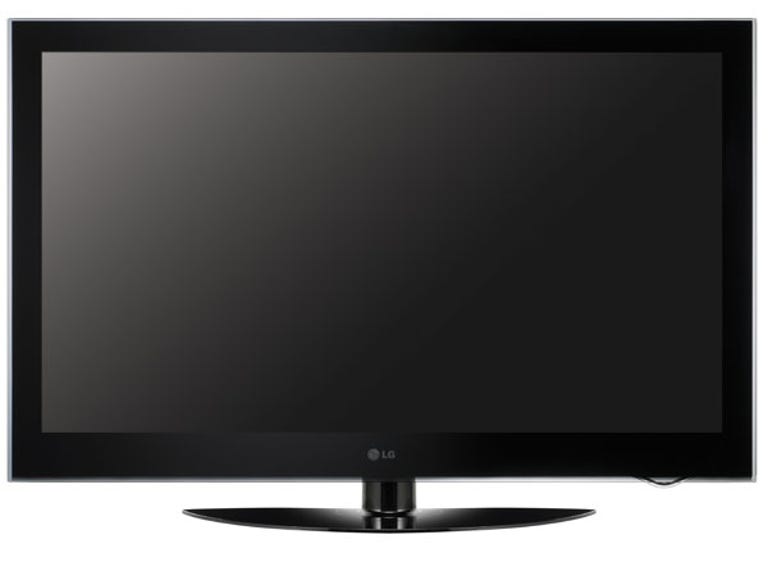
LG 42PQ60D
The Good
The Bad
The Bottom Line
Design
If we had our way, TV "design" would be a thing of the past. We've said it before, but ultimately people should be interested in the pictures, not the frames. One day, one beautiful shining day, the TV will be a flat screen millimetres thick and nothing else — you just stick it straight on the wall. No bezel, and certainly no stand to worry about...There is one thing preventing this idyll, however, and that is technology isn't able to do away without these things just yet. You still need a stand and a bezel to hold the thing up! Well, LG's new television mitigates this a little with the new "Frameless" plasma, which features a single piece of glass from edge to edge. It's still cheating, kinda, 'cos the bezel is still there, just hidden underneath the glass. But it looks nice.
The strangest aspect of the new look is the little "nub" on the bottom right corner. On previous models this was actually the power button, but here it's simply a power indicator. The power button is now located on the side, which is a shame.
The remote itself features an attractive faux-leather finish, and is quite friendly. It also comes with a couple of extra buttons designed to activate additional modes more easily — these include an "Eco" button, which activates intelligent mode TV/Rad button — sorts into radio/DTV and ANA.
Features
LG has told us previously that it has no plans to manufacture full-HD panels in the 42-inch size, and the 42PQ60D is further proof of this. While it will accept and display a 1080p signal it does this at a lower 1024x768. This can cause problems if a television scaler isn't up to the task, and as we found, the LG's wasn't. More on that later.Like a lot of televisions you'll see this year, the LG features an "Eco" mode designed to reduce the amount of power it draws by reducing the brightness. In our testing we found that you could cut down power usage by up to 50 per cent by putting this on "Maximum" versus "Off". While you can set the level manually, the Intelligent Sensor mode will monitor light levels in your room and set the brightness accordingly. The system wasn't as elegant as the one we'd seen on the latest Pioneer and the 42PQ60D darkens in obvious "steps" rather than a smooth graduation.
One feature to keep a lookout for when you next buy a plasma is 600Hz sub-field driving. This LG has it, as does a fair swathe of the new range of Panasonic plasmas. While it has very little to do with the 100Hz and 200Hz technologies seen on LCD televisions, it's a plasma-specific technology designed to reduce motion blur. The new system helps to reduce phosphor lag and flicker by updating the pixels at a slightly higher rate than the TV can actually reproduce, which makes plasmas appear to respond more quickly to a signal.
Connectivity is good for a budget plasma, with three HDMI ports, two component connections, a single S-Video port, and a USB input.
Performance
When it comes to the LG, we have some good news and some bad news. But let's begin with the "good news"...With a claimed "dynamic contrast" level of 2,000,000:1, the 42PQ60D did indeed have quite accomplished black levels. Not at KURO-bursting amounts, but certainly better than an equivalently priced LCD. Detail levels were also good — particularly with Blu-ray, and the TV was able to scope out every nook and cranny in Tom Cruise's face from our Mission Impossible III test disc. Switching to the Batman Begins Blu-ray, the picture was also impressive though we did notice some "cross-hatching" artefacts during movement — something we'd soon find familiar on this set.
DVD replay via our Marantz DV6001 player was also impressive, with zero MPEG artefacts in King Kong — the set's on-board noise processing is very good. Colours were natural and blacks inky, though there was some colour banding and cross-hatching in the tricky final scene.
Given that this plasma is selling for the same price as most 32-inch LCDs, you've got to expect some compromises. And upon turning the television on and selecting a digital channel, the nature of this compromise became clear: it doesn't have the resolution to do HD justice. While previous televisions like the Pioneer KUROs have featured exceptional scalers, which are capable of making the viewer question whether 1080p is actually worthwhile, the LG simply doesn't. Watching the One HD channel resulted in obvious vertical lines (known as vertical aliasing) through straight edges, and most obviously on boundary lines. We also found that despite the sub-field drive, the tuner wasn't able to render movement as solidly as with some other plasmas.
If you wish to use this TV in conjunction with a PC or PS3 you may be a little disappointed with text clarity — when viewing the menus on our PlayStation at its default 1080p resolution, we again ran up against aliasing problems.
Sound was decent for a television at this price, and while we didn't think much of "Cinema" mode — it was too boomy and indistinct — we found Standard better for most uses. Action scenes were well-handled and dialogue was clear. While you can also play music through the TV via the USB port we'd advise against it. On Nick Cave's Red Right Hand, the speakers twist Martyn Casey's deep-deep bass line into a bouncy Jew's Harp — boing! boing! boing!