
Like Derek Zoolander, the Motorola Aura knows there's more to life than being really, really, ridiculously good looking. But it's notsure exactly what.
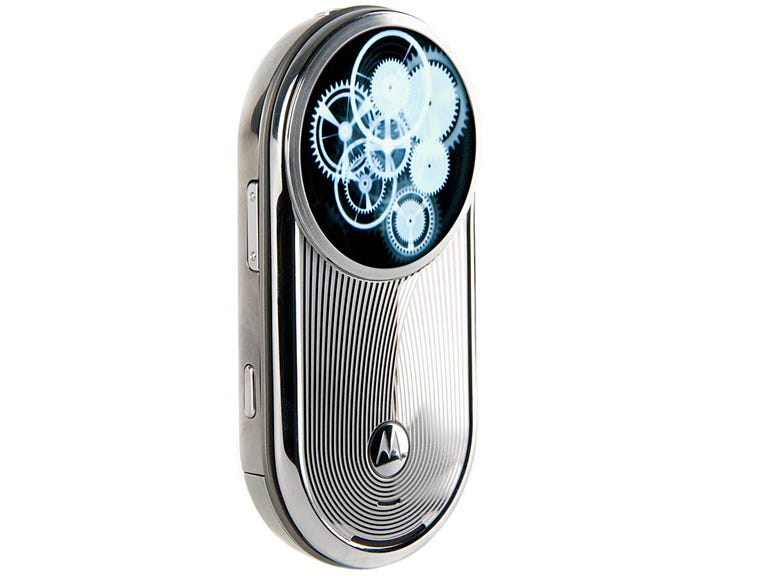
Motorola Aura
The Good
The Bad
The Bottom Line
The Aura is drop-dead gorgeous, thanks mostly to itsstunning 16-million-colour screen, but, like many fashion phones, it fallsdown on features. With an equally stunning price tag of around £1,200 SIM-free, it's got its work cut out to impress us.
Pretty but dumb
The Aura looks unique and impressive. Every time we whipped it out, we heard a chorus of 'oohs' and 'aahs'. When faced with the Aura'sloveliness, even the most curmudgeonly of cynics melted like they were looking at a baby kitten, having previously raised an eyebrow in doubt when they heard about 'the world's first circular screen'.
Part of the Aura's appeal lies in its hefty, 15mm-thick, etched stainless-steel body and rotating cover with exposed geared mechanism. But most of its charm is down to the screen, which is clear and amazingly vibrant, thanks to its 16 million colours, 300dpi resolution and a62-carat sapphire-crystal lens.
But a round screen has its drawbacks. In fact, it made usrealise why every other screen is square. For example, when we were taking photos onthe Aura's 2-megapixel camera, the corners of the image weren't visible, which madeit difficult for us to frame our snaps. After we took a photo, the Aura showedthe whole rectangular image, wasting a great deal ofscreen real estate.
We had a similar problem when surfing the Web. Web pages aredesigned for rectangular screens, so the Aura letterboxes the top and bottomof its display and cuts off the corners of the page to show a wide image withrounded sides. It works, but it reminded us that the round screen is a gimmickthat's all about looks rather than functionality. The Aura'sokay for looking something up on Google in an emergency, for example, but notfor any serious surfing.

But maybe we're being shape-ist bigots -- is it the Aura'sfault that it's a round peg in a square world? Yes, because, even within its ownuser interface, which should be round-screen-friendly, there are problems.
The main menu consists of a series of icons arranged in a circle. It would probably be a pleasure to navigate the icons using a round wheel like that of aniPod. But the Aura sports a four-way navigation button, so moving aroundthe circle requires multiple presses of the left or right directional buttons. Wewere frustrated when we wanted to manoeuvre to options on the oppositeside of the circle because they take so long to get to.
In fact, we found the Aura's user interface click-happythroughout. For example, it took 13 steps to change the wallpaper -- something we bet we'd bedoing often so we could enjoy that luscious screen. And that's if wewanted to use one of the pre-made round wallpapers -- to browse to our ownphotos required another four steps.
We also found the interface inconsistent and confusing. Forexample, when selecting a new wallpaper image, the select option's on theright function key. When choosing an option from the shortcut menu on the homescreen, the select option's on the left.
Shrunken heads
The Aura sports a 2-megapixelcamera, which takes bright but slightly fuzzy snaps in good light. But there's noflash or LED photo light, so shots in low light are noisy and blurry. But we were pleasedto find a short lag of only a fraction of a second between pressing the shutterand taking a photo.
The Aura also shoots video, but the results were dark anddingy when we filmed indoors. We were also disappointed with the playback: videosare played in the centre of the screen in a tiny 21 by 16mm square.
Even the full-screen option doesn't expand the video to fillthe round screen, although it does what it says on the tin in the case of photos. The Aura's screen is itscrowning glory, and we think it should exploit that by showing all media in a bigand round format by default. Otherwise, we end up looking at unspectacular photos andvideo on a tiny screen area -- hardly a luxury experience.
Getting sleepy
The brightness and clarity of the Aura's screen drains the battery. The Aura tries to address this by dropping into screen-saver mode within a few seconds.But, with constant use, we found the battery life to be far below Motorola's estimateof 7.3 hours of talk time and up to 400 hours of standbytime. A couple of hours of ogling the screen and a night onstandby drained the battery completely.
On the other hand, the Aura's clock function, shown when the handset is closed, shows off the screen beautifully. In fact, the clock is one of the phone's best features, and almost made us wish the Aura was a watch rather than a mobile. Motorola has obviously recognised the clock's importance, adding a shortcut from the home screen so that you can switch quickly between the five different styles available.
Sound effort
The Aura's media player supports several formats, including AAC, MP3, WAV and WMA. We found the sound acceptable when compared to that of the SanDiskSansa Fuze through some beautiful AudioTechnica headphones, but we had totest using the handset's included headphones due to its proprietary socket.The Aura's output lacks the depth and resonance of the dedicated MP3player, but we felt it would be fine for casual listening.
We used the Motorola Phone Tools software to transfer audiofiles to the Aura's 2GB of on-board memory via USB. The software looks amateurish but is easy to use, and we had no trouble setting it up ortransferring files. But be warned: Motorola has no love for the Mac. You'llneed Windows XP, 2000 or Vista to sync the Aura.
Conclusion
Motorola has joined Vertu and luxury-watch makers TAG Heuerand UlysseNardin in the rush to serve the few users who are crying out for more expensive, blinging phones. Like its rival offerings, the Aura isprimarily aimed at blinding us with its beauty and price tag, rather than its features.
It's not good for much besides making calls, but itsstunning screen, stainless-steel body and rotating cover are certainly glamorous. If you have deep pockets and you're not worried about advancedfeatures like surfing the Web, the Aura could be for you.
Edited by Charles Kloet