


The Droid Ultra's $199.99 price and even its very existence baffles me. Standing smack dab in between the affordable $99.99 Droid Mini and pricey $299.99 Droid Maxx, the only reason to choose the Ultra is either because you value trimness above all else, or don't care to spend $100 more for the Maxx's massive battery and 32GB of storage. The Ultra's limited 16GB of internal memory also makes it less enticing than other superphones such as the HTC One and Samsung Galaxy S4.
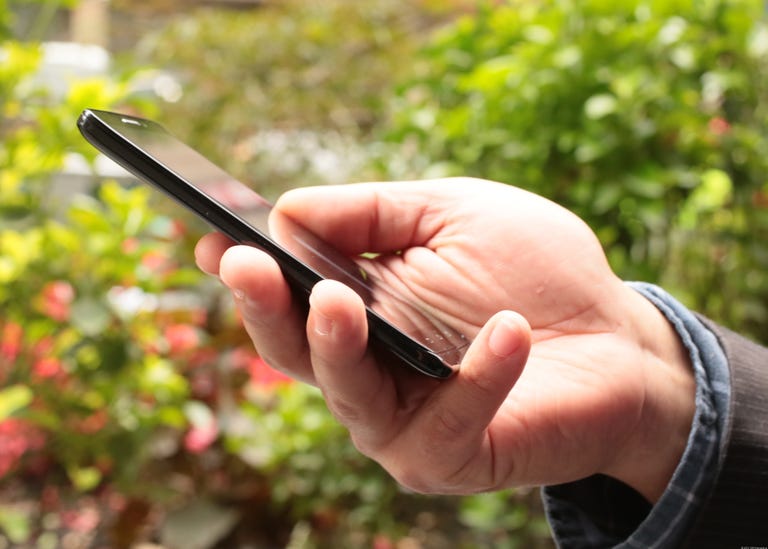
Motorola Droid Ultra
The Good
The Bad
The Bottom Line
Design
Up until the Droid Ultra landed on my desk, my most recent mobile companion was the compact Moto X. And since I've become accustomed to its petite build, when I first picked up the Ultra I was immediately struck by its large, wide frame.
Measuring 2.8 inches wide by 5.4 inches tall, the phone seemed positively gargantuan. By comparison the Moto X is a narrower 2.6 inches wide and a shorter 5.1 inches tall.
That said, while the curved edges of the X begin at a very thin 0.22 inch, at its thickest point the pint-size phone swells to 0.4 inch thick. That's a lot fatter than the Droid Ultra's flat chassis, which is a uniform 0.28 inch in thickness. At 4.8 ounces, the Droid Ultra is also relatively light considering its size.

Of course being superthin doesn't automatically make a phone ergonomically superior. As I've learned from handling the smoothly tapered backs of the HTC One and Moto X, what matters most is how a handset fits in the palm.
Both devices may be thicker and heavier (4.6 and 5 ounces, respectively) but are a joy to hold. That's because they possess a solid feel and natural shape that's extremely comfortable to grip. Just imagine a river rock honed by millennia of flowing water and you get the idea.
Compared with these gadgets, the Droid Ultra is another story altogether. It is so trim is almost feels two-dimensional, and comes close to being too wide to hold in one hand. Like the Samsung Galaxy S4, the Ultra does sport smooth, rounded edges and corners, a tactic other wafer-thin devices would do well to adopt. Case in point: the Sony Xperia Z, which has a classy all-glass chassis but also painfully sharp corners and straight right angles.
Like Sony's latest flagship, the Droid Ultra's glossy surfaces make it a fingerprint magnet. Just a few minutes were enough for me to cover the Ultra's screen and back panel in slimy streaks and prints.
Another design detractor is that the phone feels downright slippery, almost like a bar of wet soap -- not exactly a quality I seek in a smartphone. Motorola does claim that the Ultra uses Kevlar unibody construction for greater strength so hopefully it'll survive If you drop the device by accident.

The Droid Ultra doesn't have many physical buttons, just a power key and volume rocker on the device's right edge. There are three capacitive buttons below the screen to control basic Android functions. Above the display is the earpiece and 2MP camera for vanity shots and self portraits.
Around back you'll find the Droid Ultra's main 10-megapixel camera lens and LED flash. Ringing this imaging array is a sizable rectangular speaker grille. It belts out a surprising amount of volume, even more than the HTC One with its vaunted BoomSound -- quite a feat for a handset so thin.

Display
Undoubtedly the Droid Ultra's star attraction is its big, bright 5-inch HD OLED screen. With a 720p resolution (1,280x720 pixels) it may not boast the same amount of pixels as its competition, namely the HTC One (4.7-inch, 1080p LCD) and Samsung Galaxy S4 (5-inch, 1080p OLED). Even so, the Ultra's high-contrast display produces vibrant colors that pop and deep, dark black levels.
I honestly didn't notice any absent detail in photos, Web sites, or text-heavy documents. I also enjoyed viewing my typical choices for mobile entertainment on the device, a copious amount of Netflix movies sprinkled with the odd HD YouTube trailer. By the way, that new "Riddick" flick looks mighty tempting.

Core components
In terms of internal electronics, Motorola has made a very unconventional move with its 2013 smartphone lineup. Instead of engaging in the brutal processor arms race like practically every other handset maker, the company decided to sidestep the issue completely. All the new Droids, including the Droid Ultra, are powered by a homegrown processing solution Motorola calls the X8 Mobile Computing System.
The same silicon engine pushing the new Motorola flagship along (the Moto X) at its heart, the X8 is a dual-core 1.7GHz Qualcomm Snapdragon S4 Pro CPU. It doesn't have the raw horsepower of the true quad-core processors ticking inside the HTC One and Samsung Galaxy S4 (Snapdragon 600).
What the X8 lacks in brawn, it makes up for by being efficient. The main dual-core application CPU is backed by muscular quad-core Adreno graphics, plus two additional "cores": a natural language processor and one for contextual computing.
Aiding this hardware is a healthy 2GB allotment of RAM. Internal memory, though, is the Droid Ultra's weakness. As with the Moto X and Galaxy S4, the Ultra comes with just 16GB of storage space. There's no SD card slot for upping your storage options, either, which is huge bummer. Keep in mind that the Ultra's big brother, the Droid Maxx, features a full 32GB of internal storage.
Software and interface
Motorola took a similarly light-handed approach with the Droid Ultra's software as it did with the Moto X. Running the same Android operating system (version 4.2.2), the Ultra's OS is essentially stock Jelly Bean. That's understandable given Motorola's recent acquisition by Google, the technology wizards behind Android.
You slide a padlock icon outside of a virtual ring on the phone's screen to unlock the device. With that accomplished you're greeted to the central home screen plus four other panels to populate with app shortcuts and widgets as you see fit.

Motorola managed to hold on to the Circles settings widget, placed at the center of the main home screen, a leftover from the company's previous Droid Razr handsets. Aside from offering quick access to time, weather, and system settings, the tool flaunts a few new tricks.
For instance, swiping the largest clock circle uncovers fresh functions such as Droid Zap and Wireless Display. Droid Zap lets you share images and video with other Android phone users nearby while Wireless Display will duplicate the Ultra's screen to compatible HDTVs and monitors.
Besides the cornucopia of staple Google apps and services preloaded, you can dive into the large selection of titles available online in the Google Play store. Also, this is a Verizon-branded Droid device, so the carrier just couldn't resist clogging the phone with essentially useless bloatware. The unremovable hit list includes NFL Mobile, VZ Navigator, Verizon Mobile Security, and Verizon Tones to list a few.
Active display and touchless control
Another really handy feature that is also taken from the Moto X playbook is Active Display. Instead of relying on a notification light, the Droid Ultra's screen will pulse gently with alerts for incoming e-mail, text messages, and calls. Touching and holding your finger on the associated icon in the center of the screen causes the device to display additional information. Pulling the icon upwards to the top of the screen wakes up the phone and opens the linked application.
Thanks to its multicore X8 computing platform, the Droid Ultra can also perform the same voice control tricks as the Moto X. Dubbed Touchless Control by Motorola, speaking the words "OK, Google Now" causes the phone to perk up and await your vocal commands.
Saying things like "where am I?" or "remind me to pick up milk today" will tell the Ultra to jump into action. I found it to be useful when feeling particularly lazy but like Apple's Siri, a bit of a gimmick.
Performance
I know some smartphone aficionados will doubt the power of Motorola's X8 platform. I can confirm that they won't have much to fear. The Droid Ultra felt nimble, lively, and extremely responsive in my time with it. Applications opened promptly, and settings menu and home screen navigation were buttery smooth.
Benchmark tests echoed my pleasant performance experience with the Droid Ultra, notching a satisfyingly high Quadrant score of 9,056. Sure, that's not quite as impressive as the numbers turned in by the HTC One and Samsung Galaxy S4, but I'm still confident that the Ultra's speed should prove fast enough to tackle your mobile computing needs.