


The AF-S DX 35mm lens from Nikon is a well priced prime lens (AU$399) that is useful for a variety of shooting situations. Its focal length means that it's a general or normal lens, equivalent to a 52.5mm prime on a film or full frame FX camera. A prime lens is a fixed focal length lens, meaning there is no zoom. However, as a result, prime lenses are generally sharper than their zoom counterparts, have a wider maximum aperture allowing for increased flexibility in low-light shooting, and creative depth of field effects.
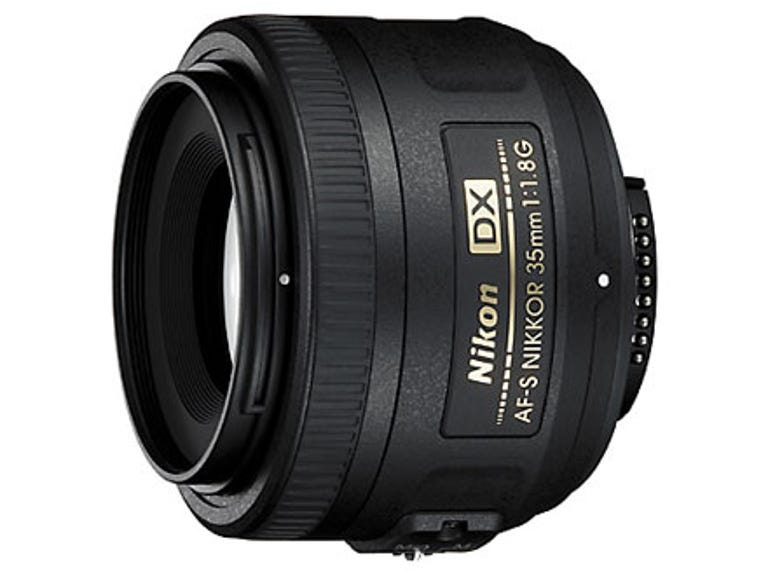
Nikon AF-S DX Nikkor 35mm f1.8G
The Good
The Bad
The Bottom Line
The DX moniker means that the lens is intended for use on Nikon's DX cameras rather than full-frame FX ones (though they can be mounted on these bodies, with resulting images at a reduced resolution and with black surrounds).
Design and features
The lens construction is metal, with black plastic casing and a rubberised focusing ring. There are no aperture ring (instead, it's all controlled through the camera) or distance measuring markers and there's just one switch, the standard Autofocus/Manual (M/A-M). Inside the box you will also get a lens hood (HB-45) and a carrying case. For Nikon's entry-level cameras without an autofocus motor built into the camera body (such as the D40, D60, D3000 and D5000), the 35mm has one built-in to the lens. The filter thread is 52mm and there is no image stabilisation (or vibration reduction) built into the lens. It weighs roughly 200g and is pretty compact, making it smaller and lighter than the kit 18-55mm lens that is paired with many of Nikon's entry-level cameras.
With a maximum aperture of f/1.8, this lens is ideal for general portraiture and can deliver some pleasing bokeh and shallow depth of field.

Even at f/3.5, the 35mm lens has some excellent bokeh and shallow depth of field. (Credit: Alexandra Savvides/CNET Australia)
Performance and image quality
Fortunately, the 35mm is a fast performer and finds focus easily in optimum lighting; in dim situations the AF assist beam works in conjunction with the lens which provides responsive and accurate focusing in under a second. Edge-to-edge sharpness across the frame is excellent, exhibiting all the pleasing properties that we have come to expect from prime lenses. Naturally, the lens is most sharp around 1.5/2 stops from its maximum aperture. The shot below was taken at f/8, 1/400, ISO 200 with a D3000.

(Credit: Alexandra Savvides/CNET Australia)
There is a degree of barrel distortion that can be seen in everyday situations, though this can be corrected in post-processing; Nikon's Capture NX software has specific functionalities to correct for distortions. Chromatic aberration is quite pronounced, especially at open apertures, though this is relatively characteristic of prime lenses at this level.
Conclusion
Most people new to SLR photography will choose a zoom lens or a telephoto as their first lens, but there's a lot to be said about prime lenses — crisp and sharp images, depth of field effects, and portability. The AF-S DX 35mm from Nikon is all of these things, and a worthwhile addition to any DX photographer's kit.