


The entry-level digital SLR market has been fairly even over the past few years, with the two big names producing good but unexciting cameras (see Canon's EOS 1000D and Nikon's D3000).
The Good
The Bad
The Bottom Line
The limitations of a low entry price restricted both companies from innovating too much on these models, but Nikon's D3100 is now the exception.
Design and features
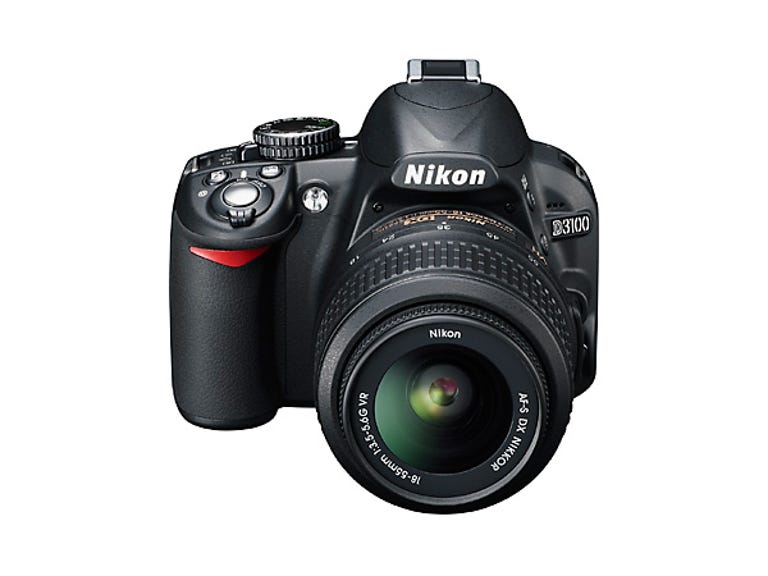
The D3100 is light and portable, weighing 455 grams for the body only. Attach a non-kit lens to the camera, such as the excellent 35mm f/1.8 DX model, and away you go with lightweight shooting. The D3100 now has a CMOS sensor and its resolution hits 14.2 megapixels. The image processor has undergone some Botox too, upgraded to Expeed 2.
Familiarity is key to Nikon's design, which uses a similar chassis and layout to the D3000, with a few extra tweaks. The most significant exterior changes come in the form of the shooting mode selector switch, now integrated into the mode dial, which changes between single, continuous, timer and quiet mode shooting.
For beginners, the D3100 is equipped with Guide mode, just like the D3000, but it has been refined to make it easier to use. Guide mode provides an interface to help new users achieve specific looks from changing aperture and shutter speeds, but without using the photographic terminology. There's also the standard PASM shooting modes accessible from the mode dial, and a range of scene modes suited to portrait, macro and landscape work to name a few.
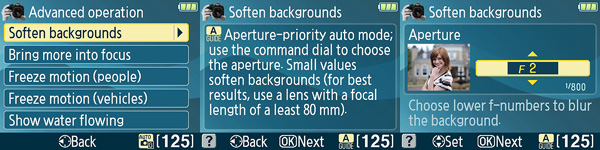
An example of the screens used in the D3100's Guide mode. (Credit: Nikon)
At the back is a 3-inch LCD screen with a resolution of 230,000 dots, a directional control pad, control wheel and a Live View switch along with the standard playback and review buttons. Live View is a much-needed addition from the D3000 and the D3100 does it brilliantly with this implementation. Simply flick the switch to the right of the screen to activate, and back again to deactivate. Video recording, which is in full 1920x1080 pixels at 24fps, is activated using the instant-on record button nestled in the Live View switch.

To the side, the D3100 has a host of connectivity options, including mini-HDMI and USB out, AV out and a port for connecting an optional GPS unit to automatically geotag photos. There is no external microphone jack though, which is disappointing for videographers.
The D3100 is easy enough for a first-time user to pick up and start shooting with straight away, either using the Guide mode or full automatic, but there are plenty of other options for more advanced photographers. One notable exception is automatic bracketing; sure, it can be done manually but it is a nice feature for those who enjoy HDR or gaining the correct exposure in tricky lighting situations.
The viewfinder is bright and clear though it's not particularly big and only covers 95 per cent of the field of view.
Compared to

| Nikon D3100 | Canon 1000D | Nikon D5000 |
|---|---|---|
| 14.2 megapixels | 10.1 megapixels | 12.3 megapixels |
| 3-inch, 230,000-dot LCD | 2.5-inch, 230,000-dot LCD | 2.7-inch, 230,000-dot articulating LCD |
| HD video (1080p, 24fps) | No HD video | HD video (720p, 24fps) |
| 11-point AF | 7-point AF | 11-point AF |
| 3fps | 3fps | 4fps |
Performance
Nikon rates the battery life for the D3100 at 550 shots.
Image quality
It's little surprise that the D3100 produces very nice images given the quality produced by the D3000. Alongside the kit 18-55mm lens, and our other review lens, the 55-300mm, the D3100 is an impeccable performer in most conditions.
Low light performance up to ISO 800 is good, so too is the natural colour tones found on JPEG images captured at default settings. Automatic white balance performance is one of the best we've seen on a digital SLR of this class, and delivers consistent results according to the ambient lighting. RAW performance is also good, and at the time of writing the latest release candidates for Adobe Camera Raw and Lightroom can read the NEF files produced by the D3100, on top of the software provided with the camera.
RAW vs. JPEG
A comparison of the RAW and JPEG processing from the D3100. The in-camera JPEG processing copes well with reducing noise without smearing or losing too much detail, an excellent result for a digital SLR of this class. The shot above was taken at ISO 1600. (Credit: CBSi)
Videos recorded using the D3100 are limited to a maximum of 10 minutes (there's a little countdown timer at the top right when recording). Rolling shutter is slightly noticeable on video files produced by the D3100 when moving the camera but for most users it won't present any issue. There is full manual control provided though with no audio tweaks, the sound quality is very much down to what the in-built microphone can do.
Continuous autofocus is provided when shooting video, which is an excellent addition for a consumer digital SLR aimed at the entry-level user, but it does need a lot of work before it can provide as seamless an experience as a dedicated camcorder. You activate it by entering into the menus while in Live View mode and choosing AF-F. When filming, the camera will continually hunt for focus and adjust as necessary, but the sound of the autofocus is very clear on the sound recording and sometimes the camera is just too slow at finding its focus point.
Image samples
 Exposure: 1/250, f/8, ISO 800 |  Exposure: 1/25, f/5.3, ISO 800 |
 Exposure: 1/500, f/11, ISO 3200 |  Exposure: 1/200, f/7.1, ISO 800 |
Conclusion
The D3100 is the best entry-level digital SLR currently available. A host of features and excellent image quality sends this camera to the top of the pack. There are some half-baked ideas though, like the difficult full-time AF in video implementation, but this is something that can hopefully be worked out in future iterations.