


When you first scoop up the Nokia 5230, chances are you'll be struck by astrange feeling of déjà vu. That's because this is essentially a rebadgedversion of the Finnish company's first ever touchscreen mobile -- the 5800XpressMusic, which was released way back in 2008. While that phonewas positioned as a flagship device, the 5230 has far humbler aspirations.
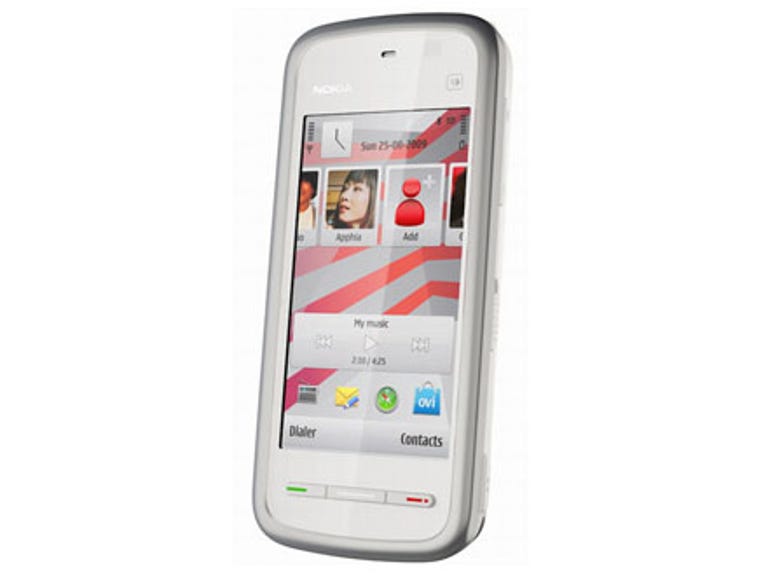
Nokia 5230
The Good
The Bad
The Bottom Line
The Nokia 5230 is available for free on a two-year, £10-per-month contract. Alternatively, you can pick it up for around £80 on pay as yougo, or SIM-free for £120.
Playit again, Sam
When placed side by side with the 5800, theNokia 5230 looks almost identical. We could forgive Nokia lazily emulating oneof its old handsets if the device in question was a designclassic, but only the most dedicated Espoo fanatic would deem the 5800attractive.

The 5230 is saddled with the same underwhelmingaesthetics that made the 5800 such an unappealing proposition back in '08. Thephone feels light and cheap, and emits worrying creaking noises when grippedtightly.The raised edging around thecorners of the screen helps protect it from bumps and scratches, but it looksnasty.
Closer inspection reveals the 5230 has endured a fewdowngrades from its older sibling. The 3.2-megapixel camera hasbeen dropped down to 2-megapixels, and the dual-LED flash has been removedentirely. Around the front, the second video-call camera has also vanished.
Aside from these alterations, the 5230 is aclose cosmetic match for the 5800. The key-guard switch remains in place, and is just asawkward to use as before, preventing quick access to the phone's functions. Themain speaker is also just as weedy as the one witnessed on its predecessor, stuck in a weird position under the battery cover.
Hardly SIM-ple
Curiously, the SIM card slot is located on the side ofthe phone, meaning you don't have to remove the battery to fit a new one.Rather than being a neat design feature, this actually turns out to be a realpain.
Inserting a SIM is easy, but getting it back out again isonly achievable by removing the battery and poking the card out with a long,thin implement -- there's no spring mechanism here. Nokia kindly recommendsusing a stylus for this task -- illustrated explicitly by an icon next to theSIM port -- yet the 5230 doesn't come with one, despite having aresistive screen.

Going resistive was one of the 5800's biggest failings. By shunning a capacitive display, Nokia saddled the phone with a disappointinglack of accuracy and responsiveness. The 5230 falls into the same trap, butit's easier to forgive this time around. It's not as though this device is being mooted as amarket leader, like the newly launched N8, and many other smart phones in thisclass only have resistive displays. Despite relying on pressure to register input,the 5230's screen is actually one of the better ones of its type that we've reviewed.
Systems down
The 5230 comes loaded with Symbian S60 5th edition -- the same OSthat Samsung and Sony Ericsson have recently announced they are dropping fromtheir phones. Long seen as the red-haired child of the smart phone world,Symbian has struggled to remain appealing in the face of the current iOS andAndroid onslaught, and the 5230 illustrates why Nokia's smart phonesoftware is lagging behind. It's counter-intuitive, slow and needlesslyconfusing, and lacks the glorious simplicity of iOS and the staggeringpotential of Android.
The functionality is there, and it's possible to create areasonably info-packed home screen resplendent with widgets, but everything isburied deep within menus and even the most basic activity is preceded by anannoying 'loading' progress bar.
The much-hyped 'Comes with Music' service, which made itsdebut with the 5800, is nowhere to be seen, but the inclusion of Ovi Maps(complete with turn-by-turn navigation) makes up for it. Access to Nokia's OviStore is also included, although it's incredibly sluggish to use.
Downloading apps and music to the 5230 isn't anywherenear as straightforward as it was with the 5800. Wi-Fi has been sacrificed inorder to bring the cost of the 5230 down, and this decision seriously limitsthe phone's appeal as a device for media-loving business types. All datatransfer is funnelled through your overburdened 3G connection, which could endup costing you a pretty penny if you intend to hit the Web on a regular basis.
Conclusion
The 5800 was hardly given a hero's welcome when itlaunched in 2008, and when you consider that the Nokia 5230 is basically aless-powerful replication of that handset, it's little wonder that it has allthe impact of a wet sponge.
Granted, the reasonable pay as you go price makes the5230's shortcomings a little more palatable, but with devices such as theT-Mobile Pulse Minialready available and the Huawei Ideos looming on the horizon, it's hard to envisage any reason to shell out for this phone -- unless you're adie-hard Nokia fan who simply refuses to switch to a rival manufacturer. Thereare far better smart phones on the market right now, making the 5230 feel likea relic from the past.
Edited by Emma Bayly