
Why should rich Western kids get all the cool kit? Nicolas Negroponte's ambitious plan to bridge the global digital divide has borne fruit at last. The XO-1 costs twice as much -- $200 (£100) -- as he'd originally hoped for, and lacks the hand-powered crank that would have freed it from the grid completely. But otherwise it's a cyber-hippy's dream come true: a simple, practical wireless laptop packed with cool new technologies and stuffed with open-source software.
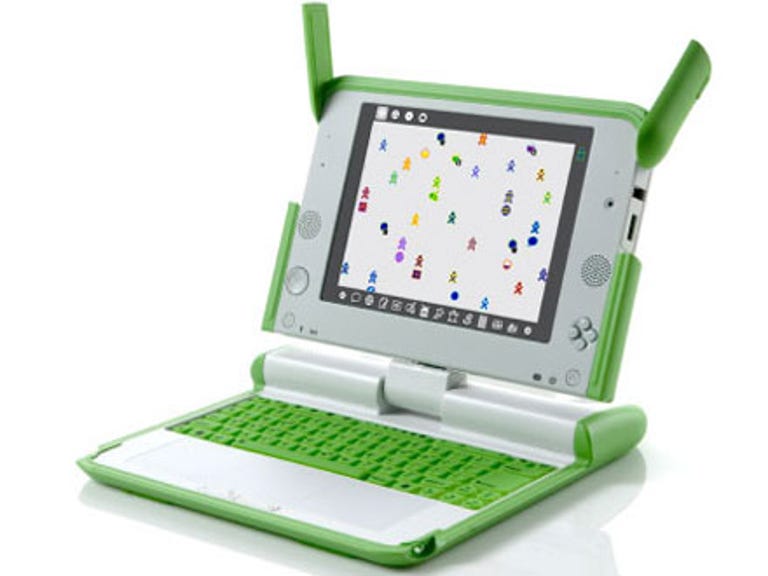
OLPC XO-1 (One Laptop Per Child)
The Good
The Bad
The Bottom Line
It's currently not available for sale to consumers, although Negroponte has said that the UK is in line for a 'Give 1, Get 1' donation programme during 2008.
Design
The XO-1's primary audience is children, who'll love the bash-it-about ruggedness, textured plastic housing and comfortable built-in grip -- no need for a poncy laptop sleeve here. There are dozens of smart design touches, from the show-off -- flip-up Wi-Fi rabbit ears that also lock the keyboard in place -- to the simply sensible -- the three USB ports are in different orientations to suit different devices and cables.
Open up the 7.5-inch screen and you're faced with a splashproof ZX Spectrum-like rubber keyboard that's definitely on the squashed side for adult fingers. The keys need a good firm press to work, but are very well laid out in a PC style, with dedicated volume and brightness buttons -- but no Caps Lock. There have been reports of problems with the touchpad, but ours worked fine.
The screen itself has gaming controls on either side -- a direction pad and four action buttons. There's also a button to flip the screen's orientation, as it can rotate through 180-degrees like a tablet, and fold back in over the keyboard. In normal use, the screen is a decent full-colour affair that's fine for Web browsing. But pull the brightness down to its minimum level and the LCD transforms into an ultra-sharp mono display that looks fantastic in full sunlight -- and saves power, too.
Features
Most new computers are built from the latest components, with a healthy over-performance margin to allow for the demands of future software. Not the XO-1. A modest 433MHz processor has to handle operating system, software and graphics all on its own, with just 256MB of RAM to work with, and a mere 1GB of Flash memory storage.
A key feature is its wireless performance. Not only do you get full 802.11b/g functionality, but also 802.11s, which enables mesh networking -- even when powered down. Get within range of another XO-1 -- tested at over two kilometres in the Australian outback -- and you can piggyback on its Internet connection, swap files or enjoy multi-player gaming. There are dedicated buttons to pull up graphical maps of your local mesh 'group' and wider wireless neighbourhood.
Multimedia features are pretty good -- a built-in VGA webcam can capture video at up to 30fps, and the stereo speakers are loud, if tinny. The XO-1 also uses brand new battery tech -- lithium iron phosphate -- that promises to last the planned lifetime of the computer, an impressive five years.
Performance
Forget Vista or even XP -- the XO-1 struggles to run Linuxunder a super-minimalist GUI called Sugar. Supplied as standard arebasic word processing, paint, calculator, chat, RSS and games software.The browser, based on Firefox, is great, and an open source Flashplayer (Gnash) even lets it work with some rich content Web sites(although none that use Java).
Creative tools are especially well represented. The TamTammusic creation suite includes easy to use composition, sequencing andeven synth tools, and there are numerous programming/scripting gadgetsto introduce kids smoothly to computing.
It's easy to download new software from OLPC's online library, and the selection of titles (all free andopen-source) is growing daily. Loading software and switching betweenpackages isn't seamless however: there are delays and crashes.
Because there's no hard drive, the XO-1 is completely silent inuse and doesn't get hot. Battery life is a healthy three hours,depending on multimedia use, thanks to clever new controllers thatpower down a large portion of the chipset when it's idle.
There should be no problems with viruses, either, as OLPC'snew Bitfrost security system forgoes firewalls and anti-virus softwarefor built-in restrictions for each program that limits the data it cansee and the hardware it can control.
Conclusion
How to summarise the XO-1: Is it aneducational tool? A fundamental reconception of computing for the 21stcentury? Or simply a high-tech toy? The one thing it isn't is a normallaptop -- that over-powered portable entertainment unit for time-poorexecutives and bored students.
The XO-1 won't ramp up yourdigital productivity or amaze you with hi-def visuals. But what itmight just do is remind you why computers are so cool in the firstplace. It celebrates its ability to communicate with people around thecorner or around the world, access information, design programs andmanipulate music, sound or pictures.
In short, this is a device for people who want to interactwith the world beyond their keyboard. In an era when downloading otherpeople's creativity accounts for 80 per cent of all Internet traffic,that can only be a good thing.
Edited by Jason Jenkins
Additional editing by Shannon Doubleday