


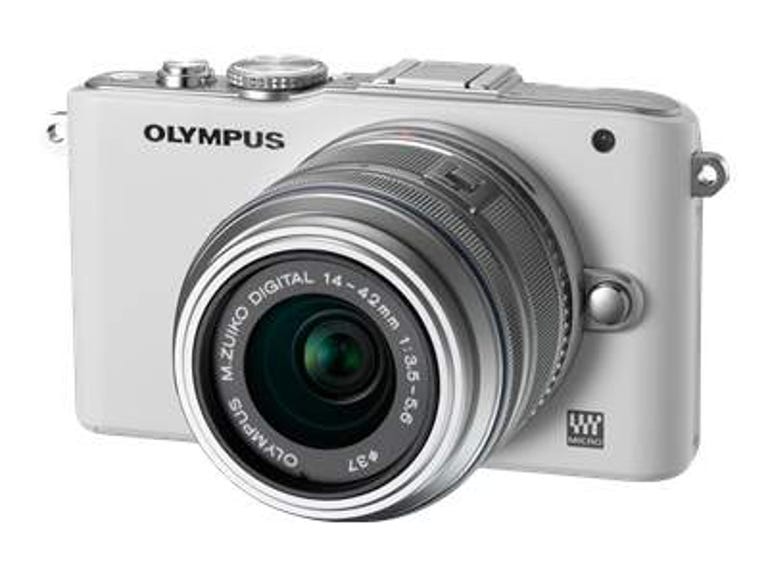
Olympus PEN E-PL3
The Good
The Bad
The Bottom Line


In many ways--pretty much everything on the inside--the Olympus PEN E-PL3 is the same camera as its more expensive sibling, the E-P3. As a result, a lot of the trade-offs I dislike in the E-P3, I'm more willing to forgive in its less expensive little brother. In part that's because I expect people considering the E-PL3 to be slightly less picky about the noise reduction quality of the JPEGs. Plus, if you're paying less you're probably less likely to be resentful about needing to tweak settings.
Like many consumer-targeted cameras, the E-PL3 produces JPEGs that show excessive smear in the details from overzealous luminance noise reduction, where the NR kicks in at ISO 800. But if you can tolerate some grain and a little bit of clipping in the shadows, you can produce much better photos at least up to ISO 1600, possibly higher if you spend a little more time on it than I did. Hot pixels also pop up in the JPEG versions of the high-ISO-sensitivity photos. At low ISO sensitivities, there's enough latitude to retouch underexposed photos without unduly increasing image noise.
Olympus also seems to push the sharpness algorithms in its JPEGs just a hair too far, which makes tiny, light-colored details (like schmutz on a flower) pop artificially. You won't notice this unless you plan to view photos at full size on a display; you won't see it when the image is scaled down and it's probably the appropriate amount of sharpening for going straight to print. And for a more natural look, shoot raw.
Exposure and color are quite good regardless of format, though. Dynamic range is better in the shadows than the highlights--I had trouble recovering some blown-out detail--but it's still pretty good overall.
The video is a mixed bag. Exposure, sharpness, color, and autofocus are excellent. But, like the E-P3, the E-PL3 has a problem with rolling shutter (you know, that wobbly effect). Turning off the image stabilization while shooting video seemed to make a difference--but without the image stabilization it gets pretty jittery. Also, the camera automatically crops the picture while shooting video, effectively increasing the focal length, which makes quickly switching between photos and videos slightly annoying. The combination of interlaced video plus relatively low bit rate also results in poor detail resolution in busy scenes, like splashing water. You can always try to shoot in 720p for those cases, however.
Except for a slightly longer startup time, the E-PL3 performs the same as its more expensive sibling. It takes about a second to power on and shoot--not an eternity but a hair longer than comparable models do. It's fast at focusing and shooting, taking about 0.3 second in good light and 0.6 second in dim. Two sequential shots toddle along quickly as well, at about 0.7 second for JPEG and 0.8 for raw. This model actually has a significantly faster burst mode than the E-P3: we clocked it at 4.7 frames per second versus 2.9fps for the E-P3. All that said, in practice I found the autofocus at least felt slower; despite its sharing the updated AF system of the E-P3, it has less processing power. And keep in mind that the continuous shooting slows down significantly after 11 shots unless you have a 30MB-per-second SD card or faster.
(Shorter bars indicate better performance)
 | Time to first shot | | Raw shot-to-shot time | | Typical shot-to-shot time | | Shutter lag (dim) | | Shutter lag (typical) |
(Longer bars indicate better performance)
Another downside is the LCD. While I love that it tilts, it seems relatively low-resolution and difficult to view in bright sunlight. I really think the optional EVF (VF-2) is a must-have, though it's pretty expensive.
I like almost everything about the design and feature set of the E-PL3, so I'll lead off with my one major gripe: there's no grip. The metal body is well-constructed, but it's a little heavy (especially with the flash attached) and the slippery front makes it difficult to shoot single-handed--something I hadn't realized I did that often. One other oddity is that I frequently, unknowingly, somehow turn the power on while swapping lenses.
Otherwise, the E-PL3 seems designed for the user who might otherwise have bought a Canon PowerShot G12 or other enthusiast "compact," though it doesn't offer the same wealth of direct-access buttons and dials that make cameras like that popular. The mode dial atop the top of the camera serves up the usual PASM and auto modes, as well as access to Olympus' well-implemented Art Filters, the typical set of scene program modes (including an odd, manual 3D option), and a dedicated movie mode where you have full manual controls and access to the Art Filters.
| Nikon 1 J1 | Olympus E-P3 | Olympus E-PL3 | Panasonic Lumix DMC-GF3 | Sony Alpha NEX-5N | |
| Sensor (effective resolution) | 10-megapixel CMOS | 12.3-megapixel Live MOS | 12.3-megapixel Live MOS | 12.1-megapixel Live MOS | 16.1-megapixel Exmor HD CMOS |
| 13.2x8.8 mm | 17.3 x13mm | 17.3x13mm | 17.3x13mm | 23.5x15.6mm | |
| Focal-length multiplier | 2.7x | 2x | 2x | 2x | 1.5x |
| Sensitivity range | ISO 100 - ISO 3200/6400 (expanded) | ISO 200 - ISO 12800 | ISO 200 - ISO 12800 | ISO 100 - ISO 6400 | ISO 100 - ISO 25600 |
| Continuous shooting | 5fps n/a (60fps with fixed AF and electronic shutter) | 3fps unlimited (LN) JPEG/17 raw | 4.1fps n/a (5.5fps without image stabilization) | 3.8fps unlimited JPEG/7 raw | 3fps unlimited JPEG/6 raw (10fps with fixed exposure) |
| Viewfinder mag / effective magnification | None | Optional | Optional | None | Optional |
| Autofocus | 73-point phase detection, 135-area contrast AF | 35-area contrast AF | 35-area contrast AF | 23-area contrast AF | 25-area contrast AF |
| Shutter speed | 1/3-1/16,000; bulb; 1/60 second x-sync | 60-1/4,000 second; bulb to 30 minutes; 1/4,000 FP sync | 60-1/4,000 second; bulb to 30 minutes; 1/4,000 FP sync | 60-1/4,000 second; 1/160 second x-sync | 30-1/4,000 second; bulb; 1/160 second x-sync |
| Metering | n/a | 324 area | 324 area | 144 zone | 1,200 zone |
| Flash | Yes | Yes | Included optional | Yes | Included optional |
| Image stabilization | Optical | Sensor shift | Sensor shift | Optical | Optical |
| Video | 1,080/60i/30p, 720/60p H.264 MPEG-4 QuickTime MOV | 1,080/60i AVCHD @ 20, 17Mbps; 720/60p @ 13Mbps | 1,080/60i AVCHD @ 20, 17Mbps; 720/60p @ 13Mbps | 1,080/60i/50i @ 17Mbps 720/60p @ 17Mbps AVCHD or Motion JPEG QuickTime MOV | AVCHD 1,080/60p @ 28, 24Mbps, 1,080/24p @ 24, 17Mbps, 1,080/60i @ 17Mbps; H.264 MPEG-4 |
| Manual shutter speed and aperture in video | Yes | Yes | Yes | No | Yes |
| Audio | Stereo | Stereo; mic input | Stereo; mic input | Mono | Stereo; mic input |
| LCD size | 3-inch fixed 460,000 dots | 3-inch fixed OLED 614,000 dots | 3-inch tilting 460,000 dots | 3-inch fixed touch screen 460,000 dots | 3-inch tilting 921,600 dots |
| Battery life (CIPA rating) | 230 shots | 330 shots | 300 shots | 320 shots | 430 shots |
| Dimensions (inches, WHD) | 4.2x2.4x1.2 | 4.8x2.7x1.4 | 4.3x2.5x1.5 | 4.2x2.6x1.3 | 4.4x2.4x1.6 |
| Body operating weight (ounces) | 9.7 | 13 | 11 | 9.3 | 9.3 (without flash) |
| Mfr. price | n/a | n/a | n/a | $499.95 (body only, est.) | $599.99 (body only) |
| $649.95 (with 10-30mm lens) | $899.99 (with 14-42mm lens) | $699.99 (with 14-42mm lens) | $599.95 (with 14-42mm lens) | $699.99 (with 18-55mm lens) | |
| $899.95 (with 10-30mm and 30-110mm lenses) | $899.99 (with 17mm f2.8 lens) | $699.99 (est., with 17mm lens) | $699.95 (with 14mm f2.5 lens) | n/a | |
| Ship date | October 2011 | August 2011 | September 2011 | July 2011 | September 2011 |
The back also offers a typical control layout that will be familiar to anyone who's used a digital camera recently. A four-way navigation-dial combo provides direct access to exposure compensation, flash, drive mode, and autofocus area options, while the OK button brings up the interactive display of all the most frequently used settings. If you're in auto mode, the settings change to Olympus' Live Guide menus, basic slider-driven options for things like brightness and saturation.
Likewise, Olympus' menu system has a couple of hidden screens you have to enable to view, one for the accessory port and one with a plethora of custom settings options. The latter includes welcome advanced controls that include options affecting autofocus areas, noise filter strength, and whether or not auto white balance should preserve the warm tone of indoor shots. There's also a programmable function button, but it's not in a convenient spot to use with any regularity, and using it in combination with the dial is downright contortionist. There are four custom settings slots, which is nice, but there's no really convenient way to switch among them.
Conclusion
The E-PL3 isn't the best at anything in its class. The Panasonic Lumix DMC-GF3 is faster, smaller, and cheaper; the Sony Alpha NEX-5N has better photo and video quality. But I like the E-PL3 for its balance of features, performance, photo quality, and design that makes many of the trade-offs worth it for the enthusiast.