
It's no secret that Pioneer has a long history of excellent televisions. We've looked at a good few of them over the years, and they have never failed to impress us. If the new Kuro screens don't live up to their hype, Pioneer has plenty to lose.
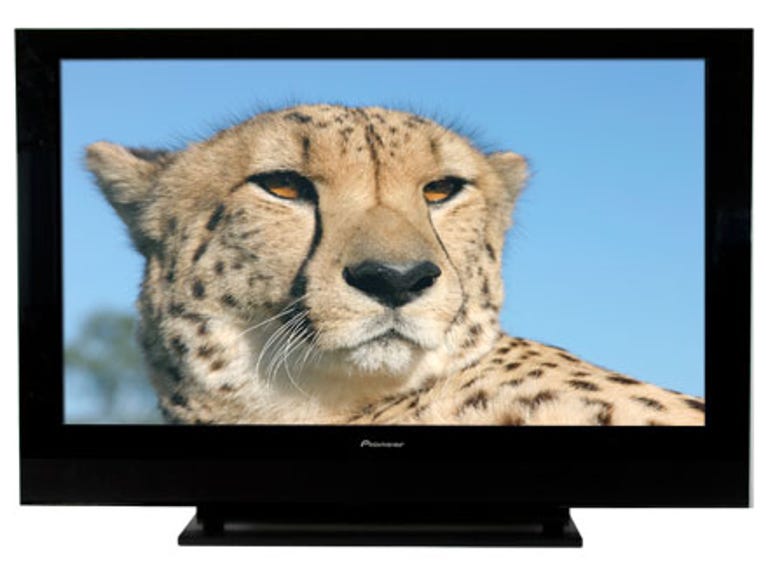
Pioneer PDP-428XD
The Good
The Bad
The Bottom Line
What is all this Kuro business anyway, and why does it matter? Simply put, Kuro translates from Japanese to 'black'. So Pioneer is essentially claiming that these screens are capable of producing the deepest blacks around. Indeed, they actually put a number on this in their press material, claiming 80 per cent better blacks. Is it true? To find out, we looked at the PDP-428XD, the 720p Kuro screen.
Design
Firstly, the 8XD range is nothing short of beautiful. Where Pioneer has got it spot on is the simplicity and understated finish. This isn't an ostentatious TV -- it's simple and clean looking and will fit into any home.

The remote control continues this fabulous styling. It seems to say, 'we know you pay more for Pioneer TVs but there is a reason'. For a start, it's made out of metal, so it has a reassuring weight and balance. The buttons on the remote are excellent, too. They have a nice feel, and they don't squelch around like some remote buttons.
The logical styling continues to the back of the TV. There, you will find all the inputs you need, including a trio of HDMI sockets, VGA and component video inputs that all serve high-definition material. There are also three Scart sockets to handle your standard definition equipment. The rear panel is home to a set of audio outputs. There are RCA stereo out, optical digital out and a subwoofer out. The rear inputs are also sensibly located within a recess designed to make wall mounting easier.
On the right hand side of the screen, there is another input panel, where you'll find S-Video and composite video in, as well as a USB connection.
Features
Pioneer has built a number of things into this television that are designed to increase its performance. First, there are the multitudes of processing systems, all of which have indecipherable names, the best of which is: 'true matrix imaging with deep waffle rib structure'. Despite the ludicrous name, that feature is key to producing a brighter image with less blur. It does this by separating the pixels in deeper channels, giving them more room away from their neighbours. There are some good explanations of the technology on the Pioneer Web site.
The 428XD also improves its picture quality by adjusting the brightness of the screen depending on the ambient light levels. This isn't a new trick but if you watch TV during the day, you'll want to have the brightness higher than in a dark room at night. The light sensor removes the need to mess about with settings manually.
Pioneer also includes a USB socket on this TV. You can view yourphotos on screen, although it requires that you plug in a USB hostcompatible device. We tested this feature with some small images wedownloaded off the Internet, and some shots from a dSLR. The Web imagesworked fine but the larger-sized images appeared to freeze the TV, and wehad to reset it before it would respond again.
We were also rather taken with the Pioneer menu system, whichis extremely well designed, and aesthetically pleasing. Simplefunctions are easy to find, with more complex ones just far enough outof reach to prevent novices messing up their picture.
Performance
This TV certainly does live up to its promise on black levels. We looked at films like Serenityon HD DVD that require a strong black next to a well-lit subject andwere amazed at how deep black space was. So if deep blacks are yourthing, this TV won't disappoint.
We were also struck by how good the movie mode was on this TV. Watching Serenity,we noticed very fluid motion at the start, with very little filmjudder. The Pioneer manages to keep this smoothing to an appropriatelevel, so it doesn't generally feel unnatural.

We really liked thepicture quality, although there were times when we thought the imagelooked a little soft of HD material. That said, the TV does ship withmost of the picture enhancement settings turned on. This sounds good intheory but in practice, a good HD signal shouldn't need much imageprocessing, so these settings can mess up the picture. As always, we'drecommend fiddling around until you get the picture to your taste.
One of the most impressive things we found with this television was the quality it managed to pull off regular DVDs. We used a Toshiba HD-E1, their low-end HD DVD player, set to output at 720p and stuck Blade IIin the tray. Moments later, our jaws were on the floor.
We've veryrarely seen such amazing picture quality from a high definition TVdisplaying a DVD. If you've got a large collection of movies on DVD,you'll be thrilled with what this TV can do. We tried a number of DVDplayers with HDMI out, and every time the TV produced a great picture.
We noticed that this screen has very little dot crawl,something that we often see on plasma screens. We could see somesparkling pixels but these were far less noticeable than other PDPswe've seen before.
Sound on the Pioneer is good. In fact, this TV has one of thebest overall sounds we've heard from a flat panel in quite some time.There is enough bass to add punch to soundtracks when needed butdialogue is clear, too. We also like the dedicated subwoofer output. Wehooked up a Jamo SUB 200, and loved the extra punch it gave us.
Conclusion
On the promise of deep blacks this TVdelivers completely. We did think at times that definition of thepicture wasn't as good as some other TVs we've seen recently. Some ofthe new 1080p LCDs, for example, and Samsung's 1080p 50-inch plasmado add more detail to the picture.
Available online for around £1,600, you'll find cheaper screenswhich boast 1080p. New LED backlights on LCDs couple improve the situation in the near future but no screen can offer anywhere near the blacklevel of this TV.
Edited by Jason Jenkins
Additional editing by Shannon Doubleday