


It's a real shame the Ricoh Caplio R7 isn't more widely available -- although you can track it down on a few different Web sites -- because it's simply a great camera.
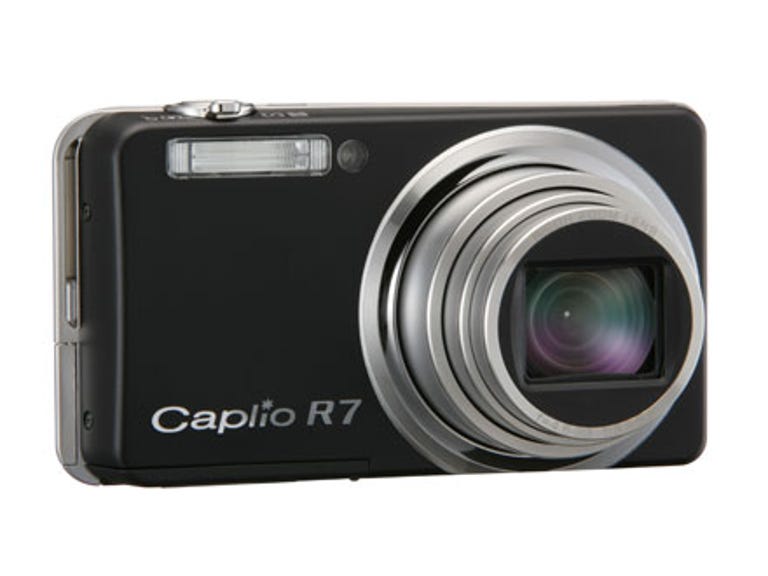
Ricoh Caplio R7
The Good
The Bad
The Bottom Line
The R7 boasts 8-megapixel resolution and isn't cheap at around £200, but there are some seriously impressive features in this understated compact.
Design
The R7 comes in black, silver or orange flavours. The metal frame is solid and sturdy, which does mean that it is quite heavy. There are a number of neat touches that demonstrate the attention to detail on this camera, like a rubber thumb rest, a satisfyingly dinky door for the USB slot and fan-shaped lens cover elements.
Unusually, some of the R7's functions are controlled by a mini joystick as well as the standard clickpad. This makes altering settings like exposure compensation or white balance much more intuitive, and we'd love to see it unleashed on a full manual mode.
Features
The R7 is pocketable if not exactly slender, but when you consider there is CCD-shift image stabilisation and, impressively, a 7x zoom in there, it starts to look very compact indeed. As well as the humungous zoom, the lens is a satisfyingly wide 28mm so you can fit more into your pictures.
The stunning macro mode lets you get as close as 10mm from your subject. The increasingly ubiquitous face detection is also present and correct. There are two zoom speed options and incremental exposure compensation. Timelapse recording is a fun feature, for up to three hour intervals between images. Sadly, there is no aperture or shutter priority, though.
Video is available in VGA or 320x240-pixel resolution at 15 or 30 frames per second.
Performance
Start-up is very quick considering that the large lens has tospin out, although it makes an alarming spidery creaking noise. Thechoice of fast zoom or slower, more precise zooming is a nice touch.
The autofocus focuses with alacrity, although themulti-weighted focus is a bit random as to what it picks out. Wequickly found it was better to switch to centre-weighted focus or usethe reliable face detection system. The bright green focus assist lampkept things in focus even in the dark. There is a tendency tounderexpose by a stop or two, but the mini joystick makes adjusting theexposure compensation a breeze.
Shot-to-shot performance is respectable, even in low light.With the flash disabled and the focus locked we managed a gap of 1.5seconds between pictures.
The only real criticism we have of the R7 is the 69mm (2.7-inch) LCDscreen. Despite a resolution of 230,000 pixels, diagonal lines are renderedhorrendously jagged. It doesn't cause problems while shooting, but itis very hard on viewing images.
Battery life is good, with the large screen not seeming to drain tomuch power as we were able to take more than 200 pictures in our tests without the camera dying.
Image quality
We were impressed with the quality of images captured by the R7.Colour is especially well reproduced, with natural skin tones andvibrant hues. Once pictures have been taken, you can also adjustbrightness and colour tone in-camera and save the results as a separatefile, cutting down on post-processing.
Conclusion
Even for around £200, the Ricoh Caplio R7 is an excellent compact that deserves a wider audience. The Canon Digital IXUS 860 ISmay have sewn up the 8-megapixel, big screen and image stabilisationmarket, but for us, the R7's innovative mini joystick and feature setgive it the edge. If it wasn't for the poor quality screen, the R7would be one of our favourite compacts.
Edited by Jason Jenkins
Additional editing by Shannon Doubleday