


Design
Did you ever take a long, hard look at your TV and say: "It's soboxy, can I have one that's a little less oppressive?" Well, you canbe sure that Samsung has, with its 2011 range arguably the best-looking TVs that have ever been invented. The D8000, or Series 8,flagship isn't as minimalist as the barely thereD7000 , yet it still features a ridiculously thin bezel. This one iscovered in brushed faux-aluminium echoing last year'sover-achieving Series9 TV. For our eyes, we prefer the way the D7000 bleeds into theroom courtesy of its clear plastic bezel, but the flagship still looksvery special.
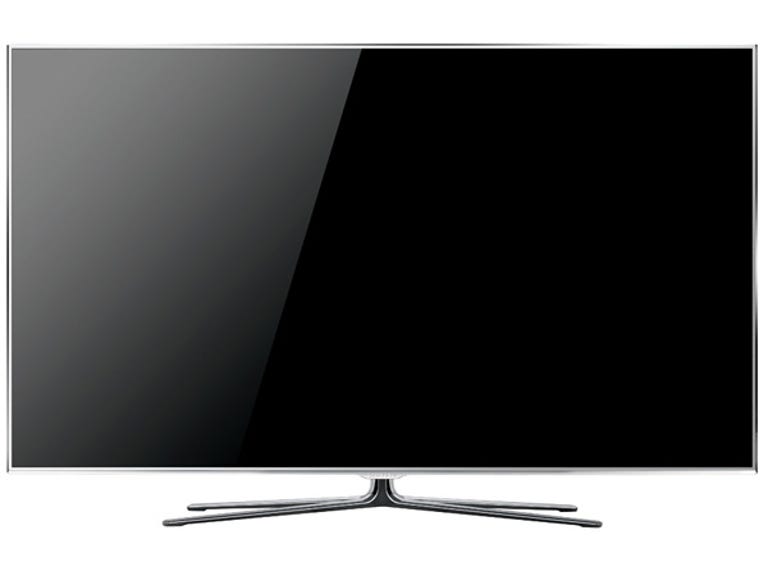
Samsung UA55D8000
The Good
The Bad
The Bottom Line
As the bezel is quite slim there isn't much room for controls sothey're mounted around the rear of the set and armed with a proximitysensor. When you put your hand behind the edge of the TV, small on-screenicons appear by the side of the bezel. Unfortunately, the sensor isn'tvery sensitive and if too close to a wall or cabinet (say a foot orless) we found that the icons would slide on and off randomly.Thankfully, the icons are only a couple of inches tall, and aren't tooobtrusive.
Like most TVs Samsung has released this year the TV includes the"four-legged space octopus" stand, which is relatively sturdy.
The Series 8 ships with the reversible QWERTYremote, which works for text input in some apps and not in others.It features a fully working remote control on the other side.
Features
The 55-inch D8000 is a smart TV and features web access andvideo on demand, with search and DLNA streaming available as standard.One of the biggest drawcards for sports fans is the inclusion of AFLand NRL Game Analyser, in addition to dedicated sports channels.BigPond Movies and TV also make an appearance.
The Samsung boasts the 3D HyperReal Engine, which is used forpicture processing in both 2D and 3D. We've had some experience withit previously and have been very impressed with its ability to cleanup noisy signals.
The D8000 also features active 3D, and if it floats your boat italso includes 2D-3D conversion — though, we like our vessels witha bit more water. The bundled glasses are much less like weldinggoggles and are actually quite slim. The glasses are designed to becharged through the TV or an a dedicated stand, but it's regrettablynot available in Australia.
At a Samsunglaunch earlier in the year, the company said it was developing a"Second Screen" function that would let you use a Samsung smartphoneor tablet in a similar way to the TV screen remote to last year. At the time of publication the feature was yet to be announced.
The Samsung comes with a whole lot of connections giving youaccess to a wide range of content. Network functions are provided viaEthernet and on-board Wi-Fi, while you can connect your gear to one ofthe three USB ports, four HDMIs, component, VGA or two composites.
Performance
Whether it was a movie, a bit of free-to-air or a game, the SamsungD8000 simply sparkled in response. The Samsung Series 8 is thetelevisual equivalent of standing at the edge of the Grand Canyon:deep, natural and yet incredibly panoramic vistas.
After testing a lot of screens that work very capably in theirnatural HD resolutions but suffer terribly at DVD replay, the Samsung'sperformance was quite refreshing. King Kong looked fantastic withsparkling, gleaming images. As the giant ape climbed to the top of theEmpire State Building you caught glimpses of the East River, whichlooked much cleaner than it would have in the actual 1930's.
The good news kept coming with Blu-ray movies, with Mission ImpossibleIII looking just as natural as we'd seen it on the D7000; though, withsome of the over-smoothness toned down and a bit of the grit allowedback in. The upshot was that movies regardless of source looked great.If we're going to sit down and watch a movie we want it to be with thenew Samsung range.
Our suite of HQV test discs further reinforced what we had seenwith movies — that film and video material were smooth and glitch-free,and has a firm grip on the digital noise. While our D7000struggled in one noise test by leaving a vapour trail behind a flockof birds, the D8000 behaved much better, and could suggest there hasbeen some software tweaks of the noise reduction strength.
While we wait for Godot to bring us some quality 3D movies, theSamsung will play what there is available now. Cross-talk is the baneof any 3D TV, and the Series 8 offers significant performanceimprovements on last year's models. Despite this, it's still a visibleartefact and Sony'sHX925 fares much better. On the flipside, the Samsung offered amore naturalistic 3D effect and didn't suffer from the flickerproblems we saw with the Sony.
While image quality is a career highlight for Samsung, the TV isn'twithout a couple of niggles. For example, the BigPond Movies serviceis a little bit limited in its content offering, we had a couple ofrandom crashes, and the QWERTY remote wouldn't work with it.
Colour is also a weak point; while movies and TV look great, itstruggles with reproducing solid colours. The vivid blue disclaimerscreen at the start of many Blu-rays wasn't consistent across thescreen with lightening at the sides, and the same occurred onall-black screens such as credits. Turning the backlight down to 1(from 20) helped a little with this, though.
Conclusion
Every year, the mantle for "best TV of 20xx" passes between thesame companies: Sony had it last year and Panasonic the yearbefore. This time the focus is back on market leader Samsung and theexcellent effort it's made in 2011 to produce products that are atleast 12 months ahead of its competitors'. While we'll wait to see what the rest of the year can throw at us, it's indisputable that theSeries 8 LCD is a truly cutting-edge television with performance atthe very heart of it.