
The Sling Media Slingbox Solo is the entry-level alternative to the Slingbox Pro. Like its big brother, it gives you access to whatever's on your home TV via mobile phone or laptop regardless of where you are in the world. It's available now for £179.
The Good
The Bad
The Bottom Line
Strengths
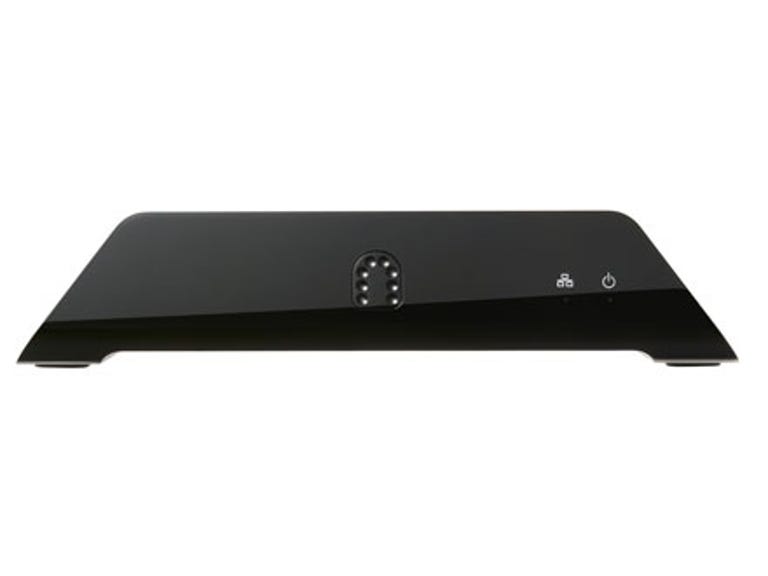
The Slingbox Solo is probably the most attractive of all theSlingbox models. Whereas the Pro is enormous, plasticky and ugly, theSolo is comparatively small, finished in glossy metal and has acontemporary air. It's by no means perfect, but this is the firstSlingbox product we'd happily display alongside the rest of our AV kit.
The basic functionality of the Slingbox Solo is the same as the original Slingbox and Slingbox Pro. It lets you watch and control your home TV on an Internet-enabled laptop or mobile phone, and does so very well.
Like the Slingbox Pro, the Slingbox Solo can be hooked up to an HD source. Fortunately, it doesn't require the unwieldy HD Connect Cable arrangement seen on the Slingbox Pro -- you simply attach a component AV cable and off you go. The device also includes composite and S-Video ports.
The Slingbox Solo (and indeed the Slingbox Pro) processes video faster than the original Slingbox. It has a bandwidth of 8Mbps, a four-fold improvement over the 2Mbps Slingbox of old.
It didn't manage the full 8Mbps in our tests, but the image quality was vastly improved over the original Slingbox when used over a wired network. Sport, in particular, went from simply being watchable to being close to broadcast quality. Movies looked great, too, particularly those with subtitles, as text is now sharper.
Be warned, though, this doesn't make a lick of difference when it's used over the Internet. Unless you live somewhere with super-fast fibre-optic broadband, the video quality is the same as the old model. For reference, you'll need at least 256Kbps upstream and downstream to watch anything at all.
Weaknesses
The Slingbox Solo can only connect to onesource. If you're the sort of user that likes to watch video frommultiple devices you're better off with a Slingbox Pro, as that canhandle up to four. The Solo also lacks an integrated Freeview tuner, soif your standard home setup doesn't include digital terrestrial TV,then the Pro is a better bet.
As with the Pro, the Slingbox Solo doesn't have a wireless adaptor-- it still needs to be connected to a wired router, or to an Homeplugstyle device (Sling Media actually makes its own brand of these, soldseparately) in order to operate.
Perhaps more frustratingly, no model of Slingbox allows you tostream high-definition content over a network, whether from an HDsource or from a second PC or server. Video streams are encoded usingSlingStream technology, so even if you start with an HD source, it'llcompress the bejeezus out of it until it looks like standarddefinition.
Conclusion
Users should buy the Slingbox Pro if they wantto control multiple sources, but otherwise the £179 Slingbox Solo is themodel to get. It delivers better picture quality than the old version,has the added benefit of supporting hi-def devices, and is miles betterthan the Sony LocationFree.
Edited by Jason Jenkins
Additional editing by Shannon Doubleday