


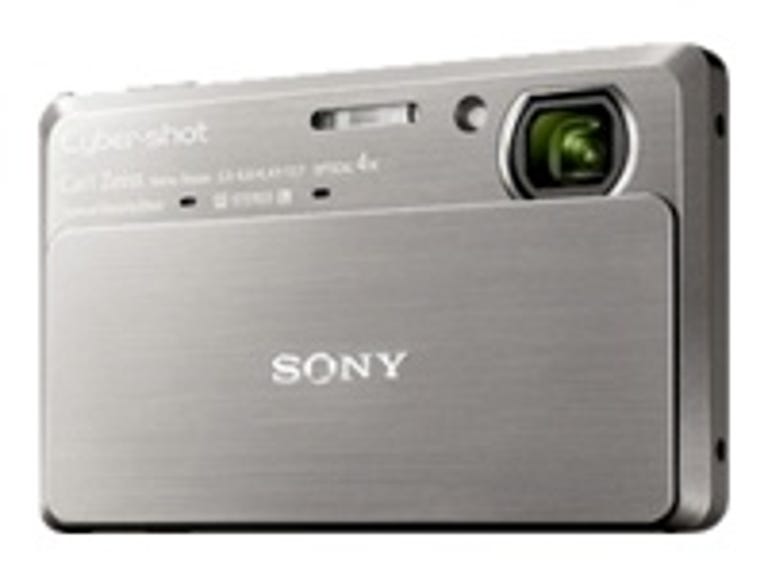
With point-and-shoot cameras, it's rare that a high price tag equates to superb photo quality and/or fast shooting performance. You're mostly paying for getting all the latest features into a very small body that you can take anywhere. The Sony Cyber-shot DSC-TX7, for example, features one of the company's Exmor R high-speed backside-illuminated sensors, a 25mm-equivalent wide-angle lens, a high-resolution 3.5-inch touch-screen LCD, and 1080i movie capture at 60 frames per second--all in a body that's just 0.7 inch thick. The sensor combined with Sony's Bionz image processor is capable of a lot of things you can't do with your typical pocket camera. And while two of those are speedy performance and very good low-light photos, its overall photo quality is less exceptional. Its photos are best suited for prints of 8x10 inches or smaller, viewing on a TV, and Web use. If your eye isn't overly critical, its features and design definitely make it worth considering.
The Good
The Bad
The Bottom Line
| Key specs | Sony Cyber-shot DSC-TX7 |
| Price (MSRP) | $399.99 |
| Dimensions (WHD) | 3.9 x 2.4 x 0.7 inches |
| Weight (with battery and media) | 5.2 ounces |
| Megapixels, image sensor size, type | 10 megapixels, 1/2.4-inch CMOS (backside illuminated) |
| LCD size, resolution/viewfinder | 3.5-inch LCD, 921K dots/None |
| Lens (zoom, aperture, focal length) | 4x, f3.5-6.3, 25-100mm (35mm equivalent) |
| File format (still/video) | JPEG/MPEG-4 AVCHD (.MTS, .MP4) |
| Highest resolution size (still/video) | 3,648x2,736 pixels/1,920x1,080 at 59.94i |
| Image stabilization type | Optical and digital |
| Battery type, CIPA rated life | Li-ion rechargeable, 230 shots |
| Battery charged in camera | No; external charger supplied |
| Storage media | Memory Stick Pro Duo; SD/SDHC cards |
| Bundled software | Picture Motion Browser 5.0, PMB Portable 5.0 (Windows), PMB Portable 1.1 (Macintosh), Music Transfer |
| General shooting options | Sony Cyber-shot DSC-TX7 |
| ISO sensitivity (full resolution) | Auto, 125, 200, 400, 800, 1,600 |
| White balance | Auto, Daylight, Cloudy, Fluorescent white, Fluorescent natural white, Fluorescent day white, Incandescent, Flash, Custom Underwater Auto, 1, 2, and Custom |
| Recording modes | Easy, Intelligent Auto, Program, Intelligent Sweep Panorama, Scene, Backlight Correction HDR, Anti Motion Blur, Hand-held Twilight, Movie |
| Focus modes | 9-point AF, Center-weighted AF, Spot AF, Flexible Spot AF (touch), Face Detection (adult/child priority) |
| Metering modes | Multi, Center, Spot |
| Color effects | None |
| Burst mode shot limit (full resolution) | 10 |

The TX7's lens quality is OK. There is some visible asymmetrical distortion at the wide end and a touch when zoomed out. Center sharpness is very good, but it drops off to the sides. The corners are particularly soft and the wide angle can cause a bit of a fish-eye effect. Fringing in images is below average to average; it is present in the high-contrast situations you would expect to see it, but it's only really visible at 100 percent and is thin enough that it could be removed with photo-editing software.
Photo color accuracy is very good with the TX7. While blues and reds maybe aren't as accurate as other colors, they're still nice looking with all colors turning out bright and vivid. Plus, they're consistent up to ISO 800; above that, things are slightly washed-out-looking. Exposure and white balance are strong as well. However, clipped highlights are a regular occurrence.
Like photo quality, movies captured by the TX7 are somewhat soft-looking, but still very good for its class. The 60i frame rate makes for some smooth movement, too. It won't replace a standalone HD camcorder, but if you'd like a single device for capturing good photos and videos, this is one of the better options available. The optical zoom does work while recording and the stereo mic is a nice extra.
If you're in the market for a spare-no-expense stylish ultracompact, the Sony Cyber-shot DSC-TX7 is worth considering. Its shooting performance, low-light photo quality, and movie options make it an excellent party companion. You're paying mostly for the design and features, though, so if your primary concern is photo quality you're probably looking at the wrong camera. Also, while its Intelligent Auto mode is reliable, you'll need to experiment with the different settings and shooting options (and read the instruction manual thoroughly) to get the most from this camera.
(Shorter bars indicate better performance)
 | Time to first shot | | Typical shot-to-shot time (flash) | | Typical shot-to-shot time | | Shutter lag (dim) | | Shutter lag (typical) |
(Longer bars indicate better performance)
Find out more about how we test digital cameras.