


Of all the new laptop designs that attempted to break into the mainstream with the launch of Windows 8 at the end of 2012, none was bolder than the slider-style PC. This handful of brave systems attempted to bridge the gap between laptop and tablet not by adding a detachable screen, but by engineering a slide-out keyboard that snapped into place at (best-case scenario) a flick of the finger.
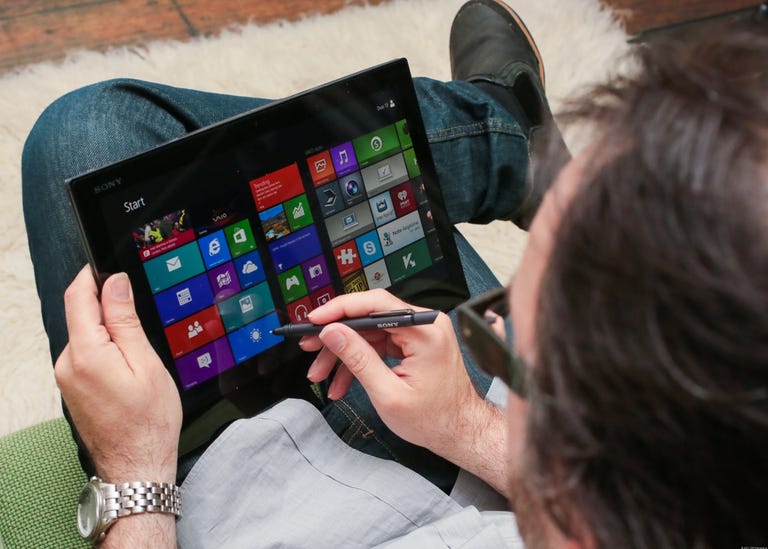
Sony Vaio Duo 13
The Good
The Bad
The Bottom Line
The main entries in this category were the Sony Vaio Duo 11 and the Toshiba U925T. Both reminded us more of old-fashioned slider phones than anything sleek and modern, and neither was particularly favorably reviewed.
I hadn't expected to see any new slider-style Windows 8 PCs, at least for a while, but Sony has surprised me with an updated and expanded version of the Duo. This new version bumps the screen size up to 13 inches from 11 inches, adds new CPUs from Intel's just-announced fourth-generation Core i-series, and is called the Vaio Duo 13.
While it's still not going to be a mainstream device, the new Duo 13 takes a stab at rebooting the slider and correcting some of the things that were so irksome about the original Duo 11. Most importantly, the sliding mechanism for exposing the keyboard is much improved and actually opens and closes easily with a single finger. It's a much smoother experience, whereas the Duo 11's hinge confused some people.
This is also a larger 13-inch screen in a fairly compact body. The Duo 11 felt like a chunky 11-inch ultraportable laptop/tablet, whereas the new 13-inch design is as thin and light as any ultrabook-style 13-inch PC (except for Sony's new Vaio Pro 13, which is amazingly light).
Also a big step forward is the touch pad. The previous Duo model couldn't fit one on, instead relying on a small pointing stick (actually a tiny optical sensor) in the middle of the keyboard. That style of cursor control still has its fans, mostly in the ThinkPad community, but it's not exactly mainstream-friendly. The touch pad here is far from perfect -- it's small, like a very short rectangle, but it's far better than not having a touch pad at all.
However, the single biggest problem with the Duo line remains, and that's the nonadjustable screen. It has two angles: flat, as in tablet mode, and up, with the screen angled well past 90 degrees. If you need to adjust the angle, or just prefer a more vertical display, you're out of luck.

Starting at $1,400 (and going all the way up to $2,700 if you max out the solid-state drive, CPU, and other options), the Duo 13 is on the expensive side for an experimental laptop-tablet hybrid. Acer's Aspire R7 also plays with laptop and tablet design preconceptions, but for only $999.
For a more traditional PC experience, Sony's other new systems, the Vaio Pro 11 and