

Bone-conduction headphones continue to increase in popularity -- particularly for runners and bikers -- as Shokz, the leading maker of bone-conduction headphones, has made incremental improvements to their design, performance and sound quality over the years. The company's current top-of-the-line OpenRun Pro is the best set of bone-conduction headphones, although it may be a little too pricey for some people.
Our Picks

The OpenRun Pro are Shokz' current top-of-the-line bone-conduction headphones. Featuring ninth-generation bone-conduction headphones, they offer slightly improved bass performance compared to the company's earlier flagship model, the Aeropex (now called the Shokz OpenRun). That makes the OpenRun Pro the best bone-conduction headphones you can get right now, although they still can't match the sound quality of traditional headphones.
Pros
- Lightweight, wraparound titanium frame
- Secure fit with open design
- Arguably the best sounding bone-conduction headphones
- Decent voice-calling performance
Cons
- Somewhat pricey
- Bass lacks fullness (not for critical listening)
- Neckband design isn't for everybody

Unlike Shokz' higher-end models, the OpenMove doesn't have as sleek a design. Nor does it feature its latest bone-conduction technology, being equipped with its seventh-generation tech with its PremiumPitch 2.0 sound. But these headphones do sound and perform better than other budget-priced bone-conduction headphones out there. In other words, while they're a step down from both the OpenRun and OpenRun Pro, they're still decent bone-conduction headphones that fit securely and comfortably (they just weigh a little more). Note that their price occasionally dips to as low as $55 during flash sales.
Pros
- Most affordable Shokz headphones
- Secure, comfortable fit
- Reasonably good sound for bone-conduction headphones
Cons
- Proprietary magnetic charging (no USB-C)
- Less sleek than step-up models
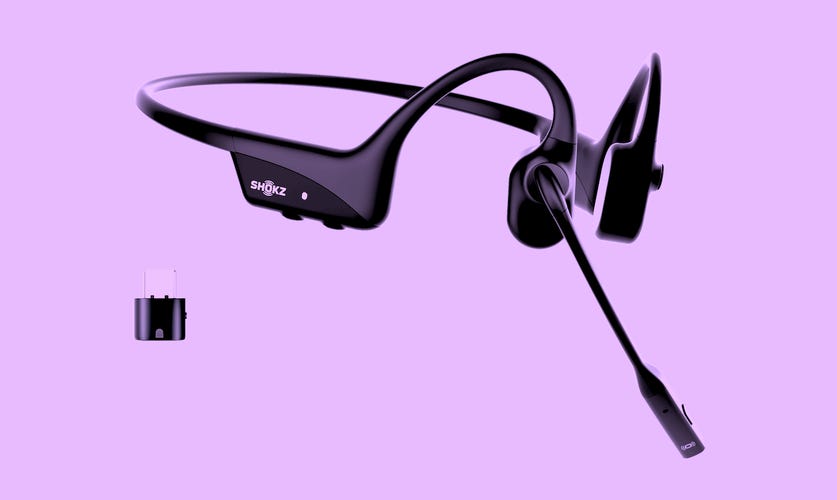
A few years ago, Shokz turned its OpenRun (formerly Aeropex) bone-conduction headphones into a more communications-friendly headset with an integrated boom microphone called the OpenComm ($160), which remains available. The second-generation OpenComm 2 UC costs more than the original, but features an upgraded Bluetooth 5.1 chipset that improves performance a bit and now allows for the firmware upgrades that are required for Zoom certification. Additionally, the microphone has moved from the left ear to the right and a convenient mute button has been added to the boom microphone -- an important addition.
Pros
- Very good voice-calling performance
- Retractable boom microphone
- Includes USB dongle for wireless PC connection
- IP55 splash-proof
- Zoom certification
Cons
- Proprietary magnetic charging (no USB-C)
- Not great for music listening with poor bass performance

Released in 2021, the Shokz OpenRun is based on the company's former top-of-the-line bone-conduction model, the Aeropex. The OpenRun's design is the same as the Aeropex, but the headphone has been upgraded with a quick-charge feature and Bluetooth 5.1. It features eighth-generation bone-conduction technology instead of the ninth-generation technology found in the step-up OpenRun Pro (that OpenRun Pro has slightly better sound quality). The Pro also has slightly better battery at up to 10 hours versus eight hours for this model. That said, the OpenRun is fully waterproof and dust-proof with an IP67 rating while the Pro has an IP55 rating, which means it's dust-resistant and can deal with a sustained spray of water.
Pros
- Lightweight design
- Fully waterproof and dust-proof
- Decent sound for bone-conduction
Cons
- Proprietary magnetic charging (not USB-C)

The OpenRun Mini is just the OpenRun headphones with a shorter neckband. The OpenRun Mini has a 0.83-inch shorter band size than the OpenRun and Shokz says that if the back of your head's measurement from the left to the right ear is 9.25 inches or less, the Mini is your better choice.
Pros
- Lightweight design with shorter neckband than standard OpenRun
- Fully waterproof and dust-proof
- Decent sound for bone-conduction headphones
Cons
- Proprietary magnetic charger (no USB-C)

The Shokz OpenSwim is a rebranded version of AfterShokz Xtrainerz (yes, OpenSwim is much better name). This model is equipped with Shokz' seventh-generation bone-conduction technology, so it's not going to sound as good as the OpenRun Pro, which uses ninth-generation tech, but you're probably not going to be doing any critical listening while swimming -- most people are just looking for passable sound while swimming underwater. Note that these don't feature Bluetooth for wireless listening; Bluetooth doesn't transmit underwater. They have 4GB of onboard storage for playback of MP3 files that you have to load onto the headphones like an old-school MP3 player.
Pros
- Can be used underwater
- Decent enough sound for underwater listening
- 4GB of on board storage for MP3s
- Fully waterproof
Cons
- No Bluetooth option for wireless listening when out of the water
HEADPHONE DEALS OF THE WEEK
- $200 (save $49)
- $248 (save $152)
- $170 (save $181)
- $398 (save $62)
While bone-conduction headphones are lacking in the bass department -- unless you plug up your ears with the included foam earplugs -- they're appealing for a few reasons. First, since they deliver sound to your ear through your cheekbones, you don't have ear tips jammed into your ears. And thanks to their open design, you can hear what's going on around you -- traffic noise in particular -- while listening to music or having a phone conversation. Also, some race coordinators don't allow runners to wear anything in their ears, which is where headphones like this come in handy.
What are the best bone-conduction headphones overall?
You may notice that there are only Shokz products on this list. That's because they're currently the best option. We've tested other bone-conduction headphones -- you can find plenty of inexpensive generic models on Amazon -- but we've always come away feeling you're better off buying Shokz' entry-level OpenMove headphones than any of those.
Here's a look at the top models. I'll update this list as new bone-conduction headphones are released.
Best bone-conduction headphones for 2025

Pros
- Lightweight, wraparound titanium frame
- Secure fit with open design
- Arguably the best sounding bone-conduction headphones
- Decent voice-calling performance
-
Cons
- Somewhat pricey
- Bass lacks fullness (not for critical listening)
- Neckband design isn't for everybody
The OpenRun Pro are Shokz' current top-of-the-line bone-conduction headphones. Featuring ninth-generation bone-conduction headphones, they offer slightly improved bass performance compared to the company's earlier flagship model, the Aeropex (now called the Shokz OpenRun). That makes the OpenRun Pro the best bone-conduction headphones you can get right now, although they still can't match the sound quality of traditional headphones.
The OpenRun Pro have a lightweight, wraparound titanium frame and are rated for up to 10 hours of music playback and you can get 90 minutes of battery life from a five-minute charge. (They have a proprietary charging cable instead of USB-C, which is not ideal.) I found them comfortable to wear, but you may occasionally have to adjust them on your head to relieve potential pressure points. While they do offer a bit fuller sound with more bass -- it's an incremental improvement, not a huge leap forward -- like other bone-conduction headphones these are strongest in the midrange where voices live so they're very good for podcasts, talk radio, newscasts and audiobooks. A hard carrying case is included as well as foam ear tips that you can jam into your ears to get better bass performance; most people use those tips sparingly.

Pros
- Most affordable Shokz headphones
- Secure, comfortable fit
- Reasonably good sound for bone-conduction headphones
Cons
- Proprietary magnetic charging (no USB-C)
- Less sleek than step-up models
Unlike Shokz' higher-end models, the OpenMove doesn't have as sleek a design. Nor does it feature its latest bone-conduction technology, being equipped with its seventh-generation tech with its PremiumPitch 2.0 sound. But these headphones do sound and perform better than other budget-priced bone-conduction headphones out there. In other words, while they're a step down from both the OpenRun and OpenRun Pro, they're still decent bone-conduction headphones that fit securely and comfortably (they just weigh a little more). Note that their price occasionally dips to as low as $55 during flash sales.

Pros
- Very good voice-calling performance
- Retractable boom microphone
- Includes USB dongle for wireless PC connection
- IP55 splash-proof
- Zoom certification
Cons
- Proprietary magnetic charging (no USB-C)
- Not great for music listening with poor bass performance
A few years ago, Shokz turned its OpenRun (formerly Aeropex) bone-conduction headphones into a more communications-friendly headset with an integrated boom microphone called the OpenComm ($160), which remains available. The second-generation OpenComm 2 UC costs more than the original, but features an upgraded Bluetooth 5.1 chipset that improves performance a bit and now allows for the firmware upgrades that are required for Zoom certification. Additionally, the microphone has moved from the left ear to the right and a convenient mute button has been added to the boom microphone -- an important addition.
Since these leave your ears open -- the sound is conducted through your cheekbone -- they aren't for people who want to seal their ears out from outside noise. Rather, the idea is that you can hear everything around you without having anything covering your ears or jammed inside them. The headset is quite comfortable to wear. Some folks find that liberating and these do feature excellent noise reduction for calls, as callers told me they heard very little background noise even when I was out on the noisy streets of New York.
While the Shokz are arguably the best-sounding bone-conduction headphones, they aren't great-sounding for music because they're lacking in the bass department. However, they're great for speech, so they work very well as a headset for making calls and listening to podcasts or audiobooks. These also have multipoint-Bluetooth pairing, so you can pair them with your phone and PC and easily switch to your phone if a call comes in while you're on your computer. And they come with either a USB-A or USB-C wireless dongle (you choose) that you plug into your computer for quick and reliable wireless connectivity.
As long as you don't mind the boom microphone, you can use the OpenComm 2 for sporting activities as well and are favorites for runners who want to keep their ears open to hear the outside world for safety reasons. They're also water-resistant. The only downside is they require a proprietary charging cable instead of USB-C. Battery life is rated at 16 hours of talk time and eight hours of listening.

Pros
- Lightweight design
- Fully waterproof and dust-proof
- Decent sound for bone-conduction
Cons
- Proprietary magnetic charging (not USB-C)
Released in 2021, the Shokz OpenRun is based on the company's former top-of-the-line bone-conduction model, the Aeropex. The OpenRun's design is the same as the Aeropex, but the headphone has been upgraded with a quick-charge feature and Bluetooth 5.1. It features eighth-generation bone-conduction technology instead of the ninth-generation technology found in the step-up OpenRun Pro (that OpenRun Pro has slightly better sound quality). The Pro also has slightly better battery at up to 10 hours versus eight hours for this model. That said, the OpenRun is fully waterproof and dust-proof with an IP67 rating while the Pro has an IP55 rating, which means it's dust-resistant and can deal with a sustained spray of water.
Overall, the Pro does feature a slightly better design and performance, but it's not a huge difference (maybe 10% to 15% better) and the OpenRun does cost $50 less.

Pros
- Lightweight design with shorter neckband than standard OpenRun
- Fully waterproof and dust-proof
- Decent sound for bone-conduction headphones
Cons
- Proprietary magnetic charger (no USB-C)
The OpenRun Mini is just the OpenRun headphones with a shorter neckband. The OpenRun Mini has a 0.83-inch shorter band size than the OpenRun and Shokz says that if the back of your head's measurement from the left to the right ear is 9.25 inches or less, the Mini is your better choice.

Pros
- Can be used underwater
- Decent enough sound for underwater listening
- 4GB of on board storage for MP3s
- Fully waterproof
Cons
- No Bluetooth option for wireless listening when out of the water
The Shokz OpenSwim is a rebranded version of AfterShokz Xtrainerz (yes, OpenSwim is much better name). This model is equipped with Shokz' seventh-generation bone-conduction technology, so it's not going to sound as good as the OpenRun Pro, which uses ninth-generation tech, but you're probably not going to be doing any critical listening while swimming -- most people are just looking for passable sound while swimming underwater. Note that these don't feature Bluetooth for wireless listening; Bluetooth doesn't transmit underwater. They have 4GB of onboard storage for playback of MP3 files that you have to load onto the headphones like an old-school MP3 player.
The OpenSwim offer up to eight hours of battery life and are obviously fully waterproof with an IP68 rating.
Factors to consider when buying bone conduction headphones
Budget
Before anything else, you'll want to figure out how much you're willing to spend on new bone conduction headphones. The quality of value-priced earbuds and headphones continues to improve, so you can find good affordable bone conduction headphones for less than $100. The premium models, which offer better build quality and performance, tend to cost more than $150 and sometimes more than $200.
Fit, aka comfort
Because of their non-traditional fit, it's key that bone conduction headphones fit your not only your ears, but your neck, too, both comfortably and securely. They should offer a comfortable fit that allows you to wear the headphones for long periods without any irritation to either part of the body.
Durability
You want bone conduction headphones that hold up well over time, so look for models that we note have sturdy build quality and a good water-resistance rating to withstand sweat, dust, and damage from drops.
Return policy
It's critical to buy your headphones at a retailer that has a good return policy, in case you have buyer's remorse. Some people who are having trouble deciding between two models sometimes buy both, try them out for a few days, and then return one.
How we test bone conduction headphones
We test our bone conduction headphones based on five key criteria, comparing similarly styled and priced models. These criteria are design, sound quality, features, voice-calling performance and value.
- Design: We assess not only how comfortable the headphones fit (ergonomics) but their build quality and how well the controls are implemented. We also look at water- and dust-resistance ratings, which are especially important for evaluating the best workout headphones.
- Sound quality: We evaluate sound quality by listening to a set playlist of music tracks and comparing the headphones to top competing products in their price range. Sonic traits such as bass definition, clarity, dynamic range and how natural the headphones sound are key factors in our assessment.
- Features: Some great-sounding headphones aren't loaded with features, but we do take into account what extra features are on board. These include everything from noise-canceling and transparency modes (ambient sound mode) to special sound modes to ear-detection sensors that automatically pause your music when you take the headphones off your ears.
- Voice-calling performance: When we test voice-calling performance, we make calls in the noisy streets of New York and evaluate how well the headphones reduce background noise and how clearly callers can hear your voice.
- Value: We determine value after evaluating the strength of the headphones against all these criteria and what the buds are able to deliver compared to other models in their price class.
Other bone conduction headphones we've tested
Shokz OpenFit: Shokz, the company formerly known as AfterShokz, has long been the leader in bone-conduction headphones. Models like the OpenRun Pro, which deliver sound to your ear through your cheekbones, are popular with runners and bikers who like to leave their ears open for safety reasons. However, Shokz's new OpenFit model, the company's first true wireless earbuds, doesn't use bone-conduction technology. They have an open design that fires sound into your ears using custom speaker drivers, which Shokz dubs "air conduction" technology.
